Content

Showing posts with label Miami Marlins. Show all posts

The man who couldn't win

August 24, 2012 1 comments

By Adam Cancryn

Twenty-three starts, 14 losses, zero wins. Chris Volstad is the hardest of baseball's hard-luck stories.

Let's start with this: Chris Volstad is not the worst starting pitcher ever. He's not even the worst starting pitcher in the last 30 years.

That distinction would go to Matt Keogh, if you're judging by Wins Above Replacement. Or rather, lack thereof. The Oakland A's pitcher finished the 1982 season nearly two wins worse than the average replacement-level player.

If you want to judge by more traditional statistics, Volstad still doesn't factor into the conversation. Mike Maroth lost a whopping 21 games with the Detroit Tigers in 2003, and don't forget about Jim Abbott: 2-18 with a 7.90 ERA while pitching for the Angels in 1996.

By those measures, Volstad is damn near serviceable. And in fact, he might not even be having the worst season this year. Nick Blackburn (4-9, 7.39 ERA) and Hector Noesi (2-11, 5.77 ERA) certainly deserve some consideration.

But what Volstad is, however, is this: the rare combination of all the bad luck, mediocre skill and terrible timing that you can pack into a 6-foot 8 frame and push out onto a Major League mound.

In case you haven't heard, Volstad is 0-9 in 13 starts this year. That follows a 2011 season that he finished off with five straight losses in 11 starts. Which is to say, the Chicago Cubs starter hasn't won a game in a while. Twenty-three starts to be exact, dating back to July 10 of last season. That's one year, one month and 14 days (and counting) since "Chris Volstad, W" appeared in a box score. The baseball world has seen five no-hitters, including two perfect games, since Volstad last left the stadium with a simple victory.

He's come close. There was Aug. 31, 2011, when then-Marlins starter Volstad pitched into the seventh of a 2-2 ballgame against the Mets. After Jose Reyes reached second, he was pulled. Reliever Michael Dunn promptly gave up an RBI single. That was the seventh winless start.

There was Sept. 23, 2011, versus the Brewers, when Volstad went seven strong innings, allowing just one run. But his offense could only muster enough to match that lone tally, and he watched from the clubhouse as Milwaukee scored three runs in the eighth and won. That was the 11th winless start.

And then there was Aug. 4, just a few weeks ago. Volstad took the mound against the Los Angeles Dodgers and turned in a brilliant performance. He lasted seven innings, scattering six hits and making just one crucial mistake: a two-run home run to Matt Kemp. For many pitchers on many days, that's all it takes to escape with a win. But Volstad's opponent was Dodgers ace Clayton Kershaw, and Kershaw was on. He allowed just one run over seven innings, and Los Angeles rode to a 3-1 victory. That was the 22nd winless start.

How do you explain going a year without a win in your chosen profession? How do you explain it to Chris Volstad? The former first-round pick once ranked as high as 40th on Baseball America's list of the 100 top prospects. He burst into the Majors in 2008, finishing with a 6-4 record and a 2.88 ERA in 15 games. His next three years were less impressive, sure, but not terrible. And at 25 years old, he had plenty of potential. Perhaps moving to the Cubs this year would provide a refreshing change of scenery, the thinking went.

Take a look at Volstad's advanced statistics, and you'll come away even more puzzled. His xFIP, which isolates a pitcher's ERA from his team's defensive performance, is 4.37. That's more than two runs lower than his generic ERA, and in line with previous years. Walks and strikeouts per nine are relatively even with his career numbers as well. Peruse the stats designed to solve baseball's mysteries, and you'll find they come no closer to solving Chris Volstad.

The good news is this: Cliff Curtis, Matt Keogh and Jo-Jo Reyes, all of whom went a record 28 games without a win before Volstad's current streak, found jobs the following year. Volstad is not doomed. This will likely not be his legacy.

And there's also this, which is good or bad, depending on your general level of optimism: Volstad will continue to take the mound every five days this season. The Cubs believe in him, and committed to keeping him in the rotation as they play out the string on another disappointing year.

It will come to an end eventually. Maybe it will happen this Sunday afternoon against the Reds, or the start after that. Or three starts down the road. But it will happen. The penance will end, and Chris Volstad will wake up, open the newspaper and see a 'W' next to his name. Until that sweet moment, there's nothing to do but go out and pitch.

Adam Cancryn is an editor and co-founder of Began in '96.
Read more »

Began in '96's Major League Baseball midseason roundtable

July 12, 2012 2 comments

By Joe Schackman, James Epstein, Adam Cancryn and Neill Thupari

The Major League Baseball season is halfway done, and we're in a bit of a weird place. The Nationals and Pirates are winning. The Phillies are down and out. And it's actually an open question whether Albert Pujols will factor into the MVP race. 

To help make sense of everything that's happened so far and predict what we might see over the next few months, Began in '96 assembled its crack team of baseball writers to take us through the most pressing questions in the Majors. 

All opinions are solely those of the author, especially when they're dead wrong. As usual, pick your battles and wage them in the comments, or Twitter-fight us like a real man @BeganIn96.

The Yankees have the best record in the American League and the Nationals are the best in the National League. Are these the two best teams in baseball? Is this who we see in the World Series?

Joe: Neither the Yankees nor Nationals will reach the World Series. The Yanks have done a great job overcoming some injuries in their rotation, but I just don’t think they’re good enough to make the World Series. Their pitching staff has question marks, Derek Jeter has regressed and Alex Rodriguez is struggling mightily. That leaves a lot of offensive production for Robinson Cano, Mark Teixeira and Nick Swisher to make up for. I don’t see that happening.

The Nationals, meanwhile, have had a few good drafts and had a particularly notable off-season this past winter to set themselves up well for the future. They’re not quite there though, and are playing a bit over their heads.

James: The Yankees and Nationals are polar opposites, but have both had fantastic first halves. New York is a veteran club with a character that battled through injuries to maintain the pole position in the tight AL East. The Nationals are the new kids on the block, finally enjoying the fruits of their years spent hoarding prospects.

But are these the two best teams in baseball? No, I don’t think so. The Yankees have overcome a lot, but I believe the Texas Rangers are the better team. The Rangers are younger and deeper, and will be players in the bidding for Cole Hamels.

The Nationals have a better shot of coming out on top, but I think the Cincinnati Reds have put it all together and will emerge from the NL. Also on the periphery are the San Francisco Giants. With their pitching, you can’t count them out.

Adam: For all the publicity that the Yankees get, I was still surprised to see them at the top of the AL East standings come the All-Star break. They’ve faced a ton of injuries, had key players struggle at the plate, and are seemingly in their eighth straight year of finally being “too old” to keep up. But this is what the Yankees do: they quietly string together a few series victories, and then next thing you know they’re 15 games above .500. That’ll continue into the second half.

But all that being said, they are still the second-best team in the AL. The Rangers have no holes, and will eventually pull away from the rest of their division. With a lineup that is somehow better than last year, and a pitching staff good enough that they can afford to slowly work Roy Oswalt into the rotation, I don’t see anyone standing in their way.

The Nationals, though, will make their first World Series appearance. They have arguably the best rotation in the National League, and possibly the entire MLB. The lineup is solid and will only get better, as a variety of players return from early-season injuries and hit their stride. And with the rest of the NL East overachieving to this point, Washington will likely pull away enough by late August to the point where they can rest young players like Stephen Strasburg and Bryce Harper. This is a good team, age be damned, and there’s no one else in the NL close enough to challenge them.

Neill: The Yankees are the best team in baseball. The AL East is the best division in the league by far, and they somehow still have a seven game lead over Baltimore. They’ve been on an impossibly hot tear throughout the past few weeks, and there’s no end in sight. It’s nice to see a small market team like the Yankees take the time to build around its farm system and create a winner with a middle-of-the-pack payroll.

Secondly, the Nationals are the not the second-best team in the MLB. We’ll see how they rebound after Strasburg gets shut down. The World Series will be Yanks and… wow, the NL is pathetic.

Mike Trout and Bryce Harper have captivated fans across the country with their precocious play. Is there anyway they keep this up in the second half?

Joe: In short: No.

Both guys are extremely talented and will be stars for years to come, but they’re rookies playing under immense pressure and scrutiny. Their teams are competing for playoff spots and the intensity will increase as we hit the home stretch. They don’t have enough games under their belts to keep up these monster numbers.

Looking at Trout’s numbers in particular, there’s a strong possibility of regression. His home-run-to-fly-ball percentage is 17.6%, which puts him on par with Joey Votto, Miguel Cabrera and A-Rod. It’s hard to see Trout maintaining that power as pitchers start to give him different looks.

James: Both have been absolutely spectacular contributors to their respective teams. Do I think it’s possible for both of them to keep that up in the second half? Absolutely. Do I think they will? I do not, for one basic reason: Rookies hit walls.

Bryce Harper is still a teenager who has never played this much baseball in his life and has never played through a September stretch. While his power numbers might not drop off significantly, I do believe you will see a decline in his .282 batting average and .354 OBP.

Mike Trout, on the other hand, has a better shot at maintaining his success because of the guys around him. He’s on an experienced team, and has Albert Pujols to guide him through the rest of the season. Again, though. I am a strong believer in the rookie wall.

Adam: I’ll break with the pack here and say that both Harper and Trout maintain their pace. There are certainly a number of factors working against them, but these two have already proven that they’re more equipped to handle the Majors than any other rookies in recent history.

Harper has shown great patience at the plate, and seems to have intimate knowledge of his limits (however high they may be). That means that he doesn’t have the holes in his swing that pitchers exploit with other rookies once they’ve seen them for the fifth or sixth time. And no matter what happens, he’ll continue to be an above-average contributor in the field and on the base paths.

I feel pretty much the same way with Trout, except his ceiling is even higher. He’s got the basic skills that don’t disappear late in the season: patience, baserunning skills and a great glove. He’ll slump at the plate at some point soon, like everyone does. But expect him to snap out of it quickly and take Rookie of the Year honors in a landslide.

Neill: I hope Trout keeps it up. Last year, I got to see the O’s play the Angels in Baltimore, and had the pleasure of sitting near Trout’s family. They were standup people who rooted proudly for their son, and it was a warm sight to see. I think Trout has a great head on his shoulders, is a class act and is someone who just gets it. He understands the game, and I hope he continues to flourish.

Harper is a classless prima donna, and I hope Cole Hamels nails him in the head soon. I hope he falls into a clown coma, bro.

Which teams are bound for a second half surge?

Joe: I think the Boston Red Sox are poised for a big second half. They have question marks all over the field, but their run differential is leaning heavily in their favor at +43. Their offense is one of the best in the game, and they’ll get Jacoby Ellsbury and Carl Crawford back at some point soon. Provided they keep scoring, the Sox are bound to improve on their .500 record.

St. Louis is also sitting pretty, just 2.5 games out of first behind the Pirates and Reds. They have the second-best run differential in the game, which technically should have translated into 50 to 51 wins. They only won 46 in the first half. Hard not to believe that will balance out over the next few months..

James: I think the Detroit Tigers are bound for a second half surge. I wouldn’t be surprised if they end up having the best record in the second half. They just have too much talent to be playing this poorly in a weak AL Central. All due respect to the White Sox and Indians, but they don’t have the firepower to get it done.

Another team likely to pick it up is the Tampa Bay Rays. Three words when it comes to them: pitching, pitching and pitching. If the Rays can pick up a bat at the deadline to better improve their anemic offense, their starters can carry them the rest of the way to the Wild Card.

Adam: It’s the Detroit Tigers. They’ve not played as badly as everyone makes it sound, it’s just that they haven’t come close to living up to the sky-high hype. At two games above .500 and sitting just behind the perpetually wobbly Indians and White Sox, they’re bound to move in front in the second half. 

The key will be getting some help from starters not named Justin Verlander. Doug Fister, Rick Porcello and Max Scherzer should be much better than they’ve shown, but if they don’t produce soon, I’d expect to see the Tigers buying at the trade deadline.

Neill: I don’t think Cleveland and the White Sox can continue to do what they’ve done in the past month or so for the rest of the season, so I see things falling into place in Detroit. Chicago doesn’t have the arms to keep pace with the Tigers’ lineup.

Also, look for San Francisco to push the Dodgers in the weak NL West. It’s so bad, I think the NCAA Champ Arizona Wildcats just got invited into the division bring it some legitimacy.

Which teams are in for a decline?

Joe: Is it cheating to say the Orioles? They’re already seven games out of first and simply don’t score enough runs to be a serious contender. 

James: The Baltimore Orioles are due for a decline. Their season reminds me of their 2007 campaign, where they got off to a fast start only to stumble down the stretch. The Orioles’ schedule gets much tougher in the second half, where they’ll have to fight through the thick AL East jungle.

In the NL, I see the Pittsburgh Pirates declining. They’ve had an amazing first half thanks to several breakout players, but the Reds and the Cardinals have more quality pieces in place.

Adam: It’s unfortunate, but I think you’ll see the Pirates start to fade. For as much credit as their pitching staff has gotten, only two full-time starters have winning records (A.J. Burnett at 10-2 and James McDonald at 9-3). Wins are overrated, that much is true. But I think in this case it reveals how close Pittsburgh has been to a total meltdown. If Burnett or McDonald hit a cold streak or are just plain unlucky, there is no one to pick up the slack. And don’t even think about counting on the offense. One-third of their lineup has an on-base percentage below .300. Andrew McCutchen can only do so much when no one’s on base. 

Neill: The Nationals shall crumble. Mark my words. Oh, so will my Orioles. But it’ll hurt more for those fair-weather fans in D.C.

Which players aren’t being mentioned right now for MVP who nevertheless stand the best chance of winning?

Joe: I think Jose Bautista will backdoor an AL MVP race that should be wide open come September. His numbers are all in line with his last two seasons, except for his BABIP. It’s criminally low at .215, meaning he’s been horribly unlucky so far. Once his luck bounces back to the norm, people will start showing him some love.

James: The two players I see coming out of the AL as MVP possibilities are Adam Jones and Albert Pujols. Jones has put together a fantastic campaign thus far, hitting .289 with 20 homers and 44 RBIs. He’s a five-tool player who will have to be in the MVP discussion as long as the Orioles remain competitive.

And you can’t ever count out Pujols. Now that he’s coming around in the AL and less focused on meeting the expectations of his contract, I expect him to lead a surging Angels team to the Wild Card.

For the NL, it’s David Wright and Hunter Pence. Wright has to be considered a candidate for MVP if the Mets remain in the playoff race. His power numbers are not what they were, but no one is more important to his team’s chances. Similarly, Pence could garner some votes if the Phillies catch fire in the second half. He’s been one of the few brights spot so far on that team.

Adam: David Wright has been essential to the Mets’ success, but the key to New York’s stretch run will be R.A. Dickey. And if the Mets are on pace for a Wild Card spot late in the season, he should be in the MVP conversation.

Dickey has been the story of the season, and despite that, his success can’t be overstated. Not only is he a knuckleballer who wins consistently (which is rare enough), he’s doing so while throwing strikes, striking hitters out and avoiding walks at rates that are elite for traditional pitchers, much less those who rely on one fluttering pitch. The most striking stat to come out of the first half for me has been Dickey’s number of wild pitches. He has one. We are watching something unprecedented in the history of baseball, and that has to count for something.

Neill:
Can I throw out Ronny Paulino (the Orioles’ backup catcher) for this one? No? How about Mark Reynolds’ fielding coach? I must admit, I haven’t paid much attention to the MVP races, because there’s just too much baseball left to be played. Albert Pujols, for example, could crush the ball in the second half and win MVP. It’s so open. As a matter of fact, I’m taking Pujols. I’m taking Pujols in the AL, and Dickey (wishful I know) in the NL. God, I love R.A. Dickey.

Can Josh Hamilton win the Triple Crown?

Joe: He can, but I don’t think he will. His stats are in the ballpark, and he has the help around him, but average will hold him back. He’s at .308 right now, and has a long way to go to catch the guys batting in the .330s.

James: If anyone can this year, it will be Josh Hamilton. The man just knows how to mash the ball. However, I do not think he will because of injuries down the line. He hasn’t shown the durability to last a full season, and could end up falling far behind Robinson Cano in the race for the AL batting title.

Adam: No. Winning the Triple Crown requires a season of full health, uncanny consistency and little competition from one-dimensional players (speedy singles hitters, home run hitting DHs, etc.). All three won’t line up for Hamilton this season.

Neill: Josh Hamilton already won the triple crown once. He was shooting up heroin while doing shots of tequila in a back room in a bar in Texas right before going home with three gorgeous Texas blondes. He can do it again. I believe in you, Josh.

Who will be the biggest name to move before the trade deadline, and where will he land?

Joe:
I don’t think Cole Hamels is going anywhere. Ruben Amaro Jr. has a reputation as a dealer, but it’s a bit misrepresented. The deals he has made involving Lee, Pence and Oswalt were no-brainers at the time, and the Phillies still have a good chance at re-signing Hamels.

Instead, I think Matt Garza will be the biggest name to move. Theo Epstein is building from scratch and will have no interest in keeping such an expensive pitcher on his roster. Teams like the Yankees, Red Sox, Orioles, Blue Jays and Dodgers are all seeking arms, and the combination of a motivated seller and multiple buyers means we’ll get a deal.

James: I think Cole Hamels gets traded to the Texas Rangers. The Phillies are getting older, and their window is closing fast. The Rangers, meanwhile, are aggressive and will make a strong push for the left hander. They have the prospects to do the trade and the money to keep him.

Adam: Zack Greinke. While Hamels has attracted much of the attention so far, Greinke is just as good and on a team that’s also going nowhere. The difference is that the Phillies have pieces on the DL (Howard, Utley) to justify sticking it out for a little while longer. Milwaukee’s time has come and gone quicker than it would have liked, and retooling while Ryan Braun is still a star will take some major moves in the short term.

Neill: As much as I want to see Zach Greinke to the O’s, I think he’s staying put. I like James’ Hamels pick. I’ve heard the Justin Upton to Atlanta rumors, but I’m not sure he’ll end up there, so I’m going to go with Garza and Ryan Dempster to the Dodgers.

Why are the Phillies so bad? Can they turn it around? What about the Tigers?

James: The Phillies are so bad for a number of reasons. They’ve had a lot of injuries, they lack great leadership, can’t hit and are getting older. Losing Roy Halladay, Ryan Howard and Chase Utley has hurt far more than expected.

As for the Tigers, I believe the team simply hasn’t come together quite yet. Detroit doesn’t have the necessary chemistry, and their pitching has struggled at times. However, I do see them bouncing back as the schedule gets easier.

Adam: Let me count the ways when it comes to the Phillies. The supposed cakewalk of an NL East suddenly turned tough. Cliff Lee has one win, and the most devastating part is that he hasn’t pitched all that bad. The lineup is so thin that Freddy Galvis starts. Juan Pierre is one of Philadelphia’s best at getting on base. This is a team suddenly in need of rebuilding, and expect Hamels and Shane Victorino to be among the ones gone before things get better.

I addressed the Tigers a bit earlier, but the bottom line is that it comes down to pitching. The Detroit lineup can hold its own, and Justin Verlander will always be a force. The question is whether they can make the move at the deadline to add another reliable pitcher. Do that, and this is not a team you want to face in a five-game series.

Neill: The Phillies are literally falling apart. Injuries keep racking up, and even though Shane Victorino and Jimmy Rollins lead the league in smiles, it’s just not enough. All those bandwagon fans jumping ship is pretty fun to watch though. Imagine how sad all these girls are going to be come October when they can’t show off their brand-spanking new custom MLB jersey that reads “Mrs. Pence” on the back?

The Tigers can turn it around because they just need to gel and get into their comfort zone. Plus, the weak division helps their chances.

What is the biggest story in baseball no one is talking about?

James: The biggest story that no one is talking about (yet) is that Mariano Rivera will be back to pitch in 2012. He will be there this October. Count on it.

Another would be how the new CBA is affecting the way teams do business. Franchises can’t recoup draft picks anymore if they pick up type A and B free agent to be at the trade deadline. The 2014 luxury tax is also forcing teams to cut their payroll and win wth homegrown talent. GMs are going to have to be more clever with where they allocate their funds going forward.

Adam: I might be a bit biased, but I think the Marlins struggles have gotten very little coverage compared with the hype when they started the season. The implosion has simply happened quicker than anyone expected. Heath Bell has lost his job more times than Billy Martin in the '80s. Starting first baseman Gaby Sanchez got demoted. Josh Johnson is a different (worse) pitcher. And the lone bright spot just underwent surgery. This is a Marlins team that was supposed to cruise to an NL East title and contend for the World Series, and halfway through, they can’t get out of their own way.

Neill: R.A. Dickey is the biggest story no one is talking about. Yes, I’ve seen the Sportscenter Sunday conversations. Yep, read the ESPN/MLB.com/SI articles too. But I just want people to truly think about what Dickey has been able to accomplish, not just this year, but since joining the Mets in 2010.

I don’t care how amazing his knuckleball is. I don’t care about the scoreless inning streak (which was downright beautiful). The fact of the matter is, R.A. Dickey is a victim of sexual abuse; a vile, disgusting crime that is all too prevalent in our society today.

Victims of sexual abuse routinely succumb to personality disorders, suicidal ideations, and multiple academic, professional and interpersonal problems. These voiceless figures don’t have families, children, a support system or meaningful opportunities to overcome their horrid pasts. They suffer in the dark, in the shadows of society as victims whom people feel sorry for, but never dare to help or understand.

R.A. Dickey singlehandedly stood up for victims of sexual abuse everywhere and proved there’s hope. He proved there is a chance for them to succeed. He proved that yes, the road is arduous and sometimes overwhelming, but the path to any semblance of normalcy exists. Dickey’s story is one that can never be told too much or too often, and it is my sincerest belief that he will inspire scores of victims across the country to speak out and start their own personal healing process. Let us never forget R.A. Dickey.

The Pirates have surprised not just because they’ve got the third-best record in the league, but because they’re doing it while barely hitting. Does this continue through the second half?

Joe: It is really kind of amazing how well they’ve done despite an inability to score runs. While I don’t think the Pirates will fall off a cliff the way they did last year, I do think they will fall off pace a little because the lack of offense leaves them walking a fine line in a division with two juggernauts in the Reds and Cardinals.

What the Pirates do at the trade deadline will be fascinating. They have a deep farm system that they can leverage into a quality major league hitter. But after years of ignoring the riches that could be found in the draft, teams are probably overvaluing their prospects. So the Pirates could sell the farm to land a Justin Upton type player, or they can be a little more conservative and go after Carlos Quentin or Chase Headley. Winning now adds more to the bottom line than potential future wins, and the Pirates should make a move to secure their first .500 season in years.

Adam: Obviously, I think they’re due for a drastic fall at some point soon. The only way they can stay competitive is to add a player or two at the deadline, preferably a power hitter and third starter. That makes these next two weeks absolutely crucial. If the Pirates come out of the break and immediately falter, they could be in third place by the time the trade deadline rolls around. If that happens, it will be much harder to convince the penny-pinchers in the front office to shell out for a big acquisition.

Neill: Just realized that I put a lot into that last response. Feeling extra sleepy and winded now. Saw the Orioles play the Pirates. Think the Orioles took two of three. The Pirates’ lineup around McCutchen is so weak that they can’t sustain their success. Not in this day and age. Their bats won’t carry them through a tough stretch in the schedule, and especially not deep into October.

Which player has impressed you the most thus far?

Joe: I’m in love with Andrew McCutchen. There was no doubting his talent before, but he’s taken it to another level. McCutchen is hitting .362/.414/.625 while playing quality defense at a premium position and racking up a 4.5 WAR. Not to mention his 14 stolen bases at a success rate just under 80%. There’s nothing this guy can’t do.

James: No one comes close to R.A. Dickey. What a phenomenal story. A guy who is in his late 30s having his best career year right after telling the story of his awful sexual abuse as a child. Beyond that, he is the last remaining knuckler. It has been wonderful watching Dickey pitch, and I only hope he continues to succeed.

Adam: Dickey and McCutchen have been great to watch. But Giancarlo Stanton is who I have to go with. He’s 22 years old, with 19 home runs and 50 RBI on a bad team, and has been a bit overlooked because of Bryce Harper and Mike Trout. But he had arguably the best month of May out of anyone in the league (1.201 OPS), and was just as valuable to his team as Dickey or McCutchen. It’s a shame that he’ll have to miss extended time due to injury.

Neill: Paulino’s still got my vote. The way he warms up Orioles bullpen pitchers is Yogi Berra-esque. He’s the modern day Roy Campanella.

As much as it pains me, I have been genuinely impressed by Robinson Cano. He’s been unstoppable. Even so, I’m taking this time to thank Kansas City and the entire Royals fanbase for my second favorite moment in All-Star week history (next to Cal Ripken’s homer in ’01), when they treated Cano the way he deserved for leaving Billy Butler off his Home Run Derby squad. Kudos to you, KC. Let him hear it.


And who has been the most disappointing?

James: The most disappointing player for me has to be Albert Pujols. I understand that it takes time to adjust to a new league, but we’re talking about “The Machine.” He’s arguably the best hitter, not only of our generation, but of all time. Nevertheless, he’s been, dare I say, human in his endeavors thus far on the left coast.

Adam: For me, it’s Tim Lincecum. There’s been rampant speculation that he’s not completely healthy, which would be a shame if the Giants are insisting on throwing him out there every few days. Whether it’s due to injury or something else, though, there is something seriously wrong with Lincecum’s mechanics. His front foot is landing too soon to let his arm rotate far enough toward its release point, jarring the body and resulting in a lot more pitches left up in the zone. That should be a simple fix, but with Lincecum’s unorthodox delivery, it’s likely a more delicate procedure than usual.

Neill: Love this question because it doubles as my comeback story for the second half of the season. Tim Lincecum has been a shell of his former self, and it’s all been put out there for the world to see. I’ve heard it from beat reporters, clubhouse managers, workout partners, etc. Tim doesn’t work out or train enough. Doesn’t push himself physically. He’s not in the shape he should be. He doesn’t work hard in the off-season. He eats poorly. He likes to drink. He’s never given up so many runs in one half of a season. The list goes on.

I could care less. I love Lincecum and have always wished the Orioles took a flier on him when they had a shot in the 2006 draft. The Orioles took Bill Rowell at ninth overall. Bill is the All-Star third baseman the Orioles are currently riding on their way to the AL pennant, in case anyone was wondering. Tim Lincecum went 10th to the Giants, and he’s, well, he’s Tim Lincecum. He’s the Freak.

Adam Cancryn and Joe Schackman are editors and co-founders of Began in '96. Neill Thupari is the site's DMV correspondent, and finally an official resident of Baltimore. James Epstein is a contributor and resident salary cap guru.
Read more »

Productive destruction

June 12, 2012 2 comments

By Adam Cancryn

Slugger Giancarlo Stanton made his name by hitting balls long and far, but he'll have to be more consistent for the Marlins to succeed.

As Giancarlo Stanton goes, so go the Miami Marlins. That's how it's been so far for the franchise and its 22-year-old star during a roller-coaster ride that has touched both extremes and yet still has plenty of season left for a few corkscrews and loops.

Miami began the year in a freefall, as did Stanton, the highly touted outfielder with a new name and what seemed to be host of new troubles at the plate. Coming off of an impressive sophomore campaign, he managed just one home run through April, a meek showing that accompanied a .247/.286/.342 split.

At the time, Stanton was not the only one suffering from a power outage, but his struggles were certainly among the more troubling. Veterans like Jose Reyes and Hanley Ramirez had proven in seasons past that they could break out of slumps, and it seemed only a matter of time before they returned to form. Marlins Park was built to their specifications, leaving them with a vast expanse of green on which to dump the doubles and triples that had made their careers up to this point.

Others off to a slow start were simply replaceable, and so their negative impact could be mitigated by similarly skilled bench players. First baseman Gaby Sanchez and outfielder Logan Morrison were among those, swapped out at times for the flavor of the day among bit contributors Greg Dobbs, Austin Kearns and Chris Coghlan. Sanchez later in the year would even be demoted, a significant but ultimately affordable step.

But Stanton was neither experienced nor expendable enough to paper over his early-season issues. He had excelled as a rookie and then blown through the so-called sophomore slump by hitting 34 home runs at the tender age of 21. That year, he led the team in at least five major offensive categories. Now, playing in a new park and perhaps up against pitchers armed with more detailed scouting reports, Stanton looked lost. He struck out 20 times in April, while managing just 18 hits. Over that same period, the Marlins went 8-14, the worst in the division.

Yet with each new month comes the reminder that, above all, the MLB season is long. Thirty days do not characterize an entire year, and even if it did, Stanton made sure to sever his ties to April as soon as possible.

On May 1, he blasted a home run, then did it again the next day. Two days later, he hit his fourth of the season and followed with his fifth less than 24 hours after that. In all, Stanton jacked 12 homers during the month, reestablishing himself as one of the game's most destructive young power hitters. Literally. He dinged one ball off the Marlins' home run sculpture in left-center, broke a panel on the team's new scoreboard with another, and dispatched one pitch to the Budweiser Balcony some 458 feet away from home plate, where it assaulted a group of beer-swilling onlookers.

Armed with a short, brutally efficient stroke, he spent the month hitting balls faster and further than the vast majority of the league. Eleven of Stanton's 12 May home runs exceeded the MLB's 103.5 mph average batted ball speed on home runs, including a 464-foot grand slam that peaked at a league-high 122.4 mph, according to ESPN Stats & Information Group. That, combined with his balcony shot three days later (114.8 mph), gave him two round trippers among the league's 15 longest home runs. He is the only player listed twice on that list.

Some great hitters are known for the distinctive sound that the ball makes off their bat. It's tough to say if that's the case with Stanton, because everyone is too busy trying to track his projectiles to much notice the sound that they made.


Apart from being a lengthy highlight reel for the Marlins, May demonstrated just how well Miami's lineup could work when Stanton is hitting. The Marlins finished the month 21-8, and went 11-2 when Stanton hit a home run. Other factors contributed to to the team's success, of course. Carlos Zambrano continued his brilliant run, relievers not named Heath Bell contributed a string of solid outings, and a multitude of hitters came up with timely extra-inning hits. But it's clear that Stanton is a crucial cog in the Marlins' lineup. He is the man that often must provide the final push for the speedy carousel around the bases that is Emilio Bonifacio, Reyes and Ramirez. Without him lasering balls into the gap and over the wall, the offense can become maddeningly inconsistent.

Or put more plainly, it can become the offense so far in June. This month, Stanton has cooled off, hitting just .243/.333/.405 over his last 10 games. And Miami is 4-7, including a stretch where it dropped six straight. After having pulled into first place on June 3, the Marlins slid back to third in the ultra-competitive NL East in a matter of days. May had been a blissful ascent, but the team is once again peering ahead at the potential for another stomach-turning drop.

To prevent that, Stanton will have to be the catalyst. It's a heavy burden to put on a 22-year-old, and one he arguably should not have to bear on a team filled with high-priced stars. But it's he who possesses the singular ability to alter the game night in and night out, to face a challenge and, with one short stroke, reverse its trajectory and send it — and the Marlins — soaring once again.

Adam Cancryn is an editor and co-founder of Began in '96. Earlier parts of the season-long series on the Marlins can be found here.
Read more »

The return of Big Z

May 17, 2012 0 comments

By Adam Cancryn

The Marlins are surging, and the man in the middle of it is as calm as ever.

Sometimes, you just need to make a change.

For the Miami Marlins, that change was as simple as flipping the calendar. After stumbling through an April filled with pratfalls both on and off the field, the team seemed to find its stride just as the month turned to May.

The Marlins began by reeling off seven straight wins, including a couple of extra-inning thrillers. Then, they took advantage of a soft spot in the schedule to climb above .500. On May 16, Miami extended that win-loss margin to three games for the first time this season. It might not have been as smooth a start as was promised during the Marlins' makeover, but the team finally appears within striking distance of its original expectations.

For the man at the center of this May resurgence, the necessary change was a bit bigger than waking up on the right side of a new month. That pitcher Carlos Zambrano is even a part of the Marlins' rotation, much less serving as its cornerstone, is the result of a series of setbacks, disappointments and last chances.

The burly right-hander arrived in Miami earlier this year in part because no one else would take him. He was a pariah throughout much of the baseball world, a man who had taken all of his blessings — a rubber arm, a powerful fastball and a raft of goodwill — and discarded them through a series of well-documented conflicts. Despite eight years of mostly stellar play for the Chicago Cubs, Zambrano's last few seasons there devolved into a string of poor outings, ejections and run-ins with just about everything that stood in his way. Umpires, coaches, water jugs and even catcher Michael Barrett found themselves on the receiving end of his rage-filled outbursts.

In August 2011, Chicago suspended him for throwing at Atlanta's Chipper Jones and subsequently getting ejected. He responded to the punishment with a tantrum that involved cleaning out his locker and declaring retirement. Somewhere along the way, Big Z had morphed into Big Me.

The exasperated Cubs shipped Zambrano to Miami for middling starter Chris Volstad and an agreement to pay some expensive postage: $16.5 million of Zambrano's $19 million contract.

It's not clear exactly when afterward that Zambrano turned the corner, or even why. He credits a reconnection with his faith and a strong relationship with manager Ozzie Guillen. Likely just as important is that Zambrano is locating his pitches much better than before and tying hitters up with a new repertoire. To date, he had struck out 2.29 batters for every one walk, a ratio that is his best since 2005. Part of that is due to the increasing reliance on a devastating splitter in favor of the less effective cut fastball he'd grown fond of in recent years. The bottom line, though, is that this is a different Carlos Zambrano. A seven-inning, seven-strikeout, one-earned-run performance on May 13 lowered his ERA to 1.88 and gave him his first win. That earned run was the only one he's allowed in three starts this month.

Best of all is that there have been no blowups, not even the first sign of a meltdown. Zambrano is missing more bats and having more success, which has put him in a better mood. Or, he's been in a better mood, which has allowed him to focus more on missing bats and being successful. No one knows what's driving what or whether it's all just one big circle, and the Marlins sure aren't asking.

There are still skeptics. It is early, after all, the dog days are yet to come, and Zambrano has spent the past few years cultivating an army of doubters. But maybe all it took was a change. During this blissful May, Big Me is nowhere to be found. And Big Z, well, he's throwing free and easy again.

Adam Cancryn is an editor and co-founder of Began in '96. Earlier parts of the season-long series on the Marlins can be found here. 
Read more »

The Marlins' leaky spring

May 3, 2012 0 comments

By Adam Cancryn


Heath Bell was supposed to be one of the Marlins' strengths, but he's quickly turned into their greatest weakness.

We are not yet a month into the 2012 season, and already the Miami Marlins have sprung a leak. Literally.

A number of the panels across the organization's 8,000-ton retractable roof have submitted to Florida's relentless spring showers, treating unlucky fans in a certain few sections to the drip-drip of the new stadium's inevitable growing pains.

Leaks are a normal occurrence in retractable roofs, Marlins chief arm-twister David Samson assured the media on May 2. Stadium workers have been busy in recent days opening the faulty panels and patching their joints. It's just a matter of plugging the trouble spots with gum, he joked. (Though it's not much of a stretch to venture that Samson doesn't actually know how the panels are fixed. He's paid to get things done, not to worry about how they're getting done.) Fixing the problem for good could take take the entire year, but all told, a few raindrops rank as just a minor issue.

What weighs heavier on the organization's mind is its on-field leak, closer Heath Bell. Bell was supposed to be the Marlins' ultimate stopper, a lights-out pitcher who would secure the team's late-inning leads. Instead, he's become the largest tear in the fabric of Miami's carefully constructed team.

The Marlins had good reason to believe Bell would earn the $27 million they gave him this offseason, a a princely sum within a broader market for closers that is less than enthusiastic. He had ranked among the best relievers for five years, and was a top closer for the past three. From 2009 to 2011, Bell recorded 132 saves — most in the Majors — against just 14 blown saves, a 90 percent success rate. He had been a workhorse in his time with the Padres, and would serve as the anchor for the Marlins' bullpen.

But just as $515 million can't guarantee a stadium without leaks, there was no absolute guarantee that Bell could remain on his fantastic path. And so far this season, Bell is lost in the woods. The closer has blown three saves, turning the Marlins' prospective wins into crushing losses. During one of those losses, Bell threw 42 pitches. The effort yielded four walks, two runs, and just two outs. He ended April with a 10.80 ERA and two saves in five chances.

Amid his struggles, there have been whispers that perhaps the Marlins should have seen this coming. Bell is 34 years old, placing him squarely on the downside of his career. Hidden behind last year's gaudy headline numbers was a significant drop in his strikeouts per nine innings, to 7.3. Bell had never dipped below 8.2 in his entire career. And San Diego's spacious Petco Park is notorious for boosting pitchers' stat lines. All seemed to foreshadow a regression, one that has played out so far this year. Bell is striking out just 5.9 batters per nine innings, while walking a staggering 9.4 per nine. Those ratios are a pitcher's death knell.

The Marlins aren't buying into that line of thinking, though, at least not yet. Nine games is a tiny sample size for a closer used to pitching 60+ games, and April is baseball's weirdest month. Albert Pujols has no home runs. Tim Lincecum's racked up a 5.74 ERA. Marlins Park is leaking. Odds are, these early disappointments will be little more than blips in the long run.

Bell is already doing his best to prove that, hurling a 1-2-3 ninth to save the Marlins' 2-1 win on the first day in May. Miami hopes it's a sign that thing are getting better. At 10-14 and sitting dead last in the division, things must get better. Otherwise, not even all the gum in the world will be enough to patch up the Marlins' floundering season.

Adam Cancryn is an editor and co-founder of Began in '96. Earlier parts of the season-long series on the Marlins can be found here. 
Read more »

Lions in the boardroom, lambs on the field

April 24, 2012 0 comments

By Adam Cancryn


A new documentary series exposed the Marlins' brash, anything-goes business style. 

There's a scene in the first episode of Showtime's documentary series following the Miami Marlins where team president David Samson is describing the hassles involved in securing the Marlins' stadium deal.

After launching into the kind of ill-conceived metaphor involving salmon and sex that could only be delivered by a deluded narcissist like Samson, he finally reaches the bottom line:

"The payoff for all of the lawsuits and all of the fighting and all of the tension and stress and insanity," he says, gesturing to the camera as he hurtles down a Miami highway, "the payoff is to see people enjoy the ballpark and winning games."

All of it is worth it if the Marlins make money and win a championship. The ends justify the means. It's a sentiment that fits not just the arm-twisting organization's campaign for a stadium, but its entire approach to this season. The bold offseason moves, the hundreds of millions of dollars spent, the bridges burnt, it was all done in the name of a championship. And they'll continue to do what it takes to reach that goal, right up until they achieve it or go down in flames.

That attitude is nothing new, especially in the sports world. All successful franchises must be willing to spend money and make hard choices to win a title. But few have brought the kind of smarmy, top-down arrogance to the pursuit that the Marlins' executives have.

The moral bar for the entire organization is set by owner Jeffrey Loria, an individual who has proven as toxic as any in baseball. An art dealer with a knack for wearing out his welcome in record time, Loria flipped the Montreal Expos for a tidy profit and then purchased the Marlins in one smooth motion. Once in Florida, any goodwill he'd built up by winning two World Series was quickly exhausted by the subsequent fire sales that left the team depleted in order to keep his pockets fat. But Loria is willing to step on everyone and jump in bed with anyone to get what he wants, a strategy that has helped him retain and expand his power. First, he negotiated a stadium deal that stuck taxpayers with 80% of the $515 million price tag, resulting in the recall of Miami-Dade Mayor Carlos Alvarez and an SEC investigation into stadium-related bond sales and campaign contributions made by the franchise.

Then he set his sights on his own team, forcing star Hanley Ramirez to move to third base to make way for incoming shortstop Jose Reyes. Loria's attitude, as captured by the Showtime cameras, was that Ramirez would simply have to deal with it. Also joining the Marlins this offseason was pitcher Carlos Zambrano, a pariah known for his on-field meltdowns, off-field tantrums and divisive attitude. Loria, however, saw only a talented pitcher available for a low price. Managing that investment would be someone else's problem.

Sitting at Loria's right hand is Samson, a man whose temperament meshes well with Loria, and not just because he's his stepson. Samson is a lap dog masquerading as the Alpha dog, wrapped in a Napoleon complex and weighed down by the massive chip on his shoulder. He stalks the Marlins' hallways, always half-eyeing his Blackberry, doing all of Loria's dirty work. Whether it's pushing through the stadium deal or suspending manager Ozzie Guillen, Samson is the point man. (Loria is conspicuously absent during the meeting with Guillen, and is rarely shown outside his office, except when hamming it up with players, playing the role of benevolent boss.)

"Sampson is the villain in many people's eyes," Showtime's narrator says, and it's a role he embraces.

In March, he implied that Miamians were stupid ("I don't have to hold back now that the stadium is built. We're not the smartest people in Miami") and that Reyes was greedy ("[Reyes] said 'I really want to play in Miami as long as you pay me $1 more than anyone else ... I really want to make the most money I can").

But being the blackhearted bulldog has gotten Samson where he is today, nepotism notwithstanding, and that appears to be all that matters. The ends justify the means.

The third member of the Marlins' trifecta is Guillen, and it's Guillen who puts the 'Fuck' in the organization's Go Fuck Yourself persona. A gifted manager with absolutely no filter, Guillen racks up 97 F-bombs in his opening speech to the team, a statistic Loria proudly presents to him afterward.

Unlike Loria and Samson, though, Guillen is hard to dislike from a distance. His honesty plays well on the diamond, and he is one of the only managers capable of juggling Miami's array of clubhouse personalities. Even after his controversial comments about Fidel Castro ("the only thing you can't say in this market"), there is never the sense that his job is in jeopardy. The fit is too perfect. Samson chastises Guillen, and then in the same breath tells him not to let the mistake change who he is. When the two hug and Samson says he loves him, it is perhaps Samson's most human moment on screen. Even if he says "I love you" in the way you'd say it to a car or a flat-screen TV, and with the implied understanding that his love is contingent on the Marlins winning.

Fifteen games in, the Marlins haven't been winning as much as expected. They've clawed their way to 7-8, but Reyes is still struggling and the bullpen is a mess. On April 21 against the Nationals, the team fought back to tie the game late, only to lose in extra innings because of a muffed double play attempt. It served to sum up the flashes of brilliance interrupted by long bouts of ineptitude that have been a hallmark of the season's early weeks. Worse yet, Miami ranks ninth out of 16 in attendance.

"We want people to fucking hate this ballclub," Guillen tells his team at one point. "Because when people hate somebody, it's because they're fucking good."

The Marlins don't have to worry about that first part, at least. Loria, Samson and even Guillen himself have made enough enemies to fill Marlins Park to capacity. And perhaps that's just the price of doing business. But on the field, it's become clear that winning will take more than loose morals and a sharp tongue.

Adam Cancryn is an editor and co-founder of Began in '96. The first part of a season-long series on the Marlins can be found here.
Read more »

Meet the Marlins: Baseball's loudest, brightest and most ambitious three-ring circus

April 17, 2012 0 comments

By Adam Cancryn


The Marlins aspire to be their city's cultural icon, but must first concentrate on winning a few games.

This is not the start that they had in mind.

The Miami Marlins' inaugural season was supposed to be a season-long Carnivale, the start of a new era not just for the Marlins, but for the city as a whole. The downtown stadium would be Miami's new hotspot: a pulsating mashup of Pitbull and pelota, a place where thousands come to party, swaying in step with a new brand of baseball build on speed, flash and flamboyance.

From the fluorescent logo to the garish green stadium walls and the monstrosity in center, the message was clear. This wasn't your traditional American baseball, with its pre-packaged reverence for tradition and forefathers, sponsored by Chevy and backed by a stirring Toby Keith anthem. This was beisbol, a celebration of Latin culture played nine innings at a time for a city that identifies with the Hanleys and Joses far more than the Marks and Johns. "The Miami Marlins are the team of the people. Of our people," is the image that the franchise created for itself.

The problem with any image, though, is that it shatters without substance to support it. And for all its attempts at establishing its Latin identity, it took little time for the Marlins' carefully crafted campaign to fall apart.

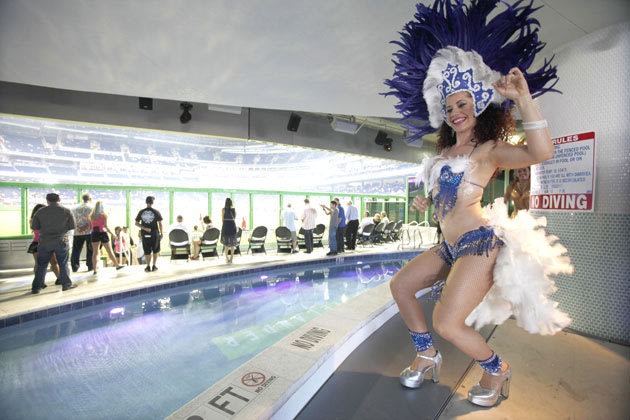
The team's Opening Night ceremonies involved trotting out women wearing what seemed like traditional Carnivale garb to escort the players onto the field. Unfortunately, the skimpy costumes skewed a bit too far toward the escort side of things, making the Marlins' first attempt at celebrating Miami's culture look like a hamfisted stereotyping dreamt up by a group of old white men.

The encore proved even more cringeworthy. In a decision that surely sounded far better in theory than execution (a theme that developed throughout the team's first weeks), the Marlins wheeled out Muhammad Ali for the first pitch. Rather than serving as a tribute to one of his great boxing victories, Ali's appearance only managed to remind those watching of their own mortality.

Ravaged by Parkinson's Disease and barely in control of his movements, the former world champion trudged across the outfield on the back of a golf cart as initial cheers gave way to an awkward murmur. Marlins owner Jeffrey Loria sat beside Ali, giving him patronizing pats on the knee and looking for all the world like the worst person in Miami.

The Marlins had envisioned Opening Night as a vibrant beginning. Before the first pitch, it was an exploitative failure.

***

Still, there was baseball to play. All was not lost, the party could be saved. If only Jose Reyes made a slick play in the hole, or Hanley Ramirez hit his first big fly, the place would crank right back up again.

But those plays never came. The oppressive Miami heat swallowed up the Marlins' offense. The opposing Cardinals, playing as if they were the ones this expansive park was made for, dinked and dunked their way to a 4-1 win.

For the Marlins, the night's enduring, and perhaps most appropriate image: Young star Giancarlo Stanton after smashing a pitch to left center, all his might and effort put into one big swing, following the ball's arc until it landed with a thud in the outfielder's glove, well short of the wall.

***

Since that first night, little has gone right and nothing has gone as perfectly as the Marlins envisioned. On the field, the team has struggled. Ace Josh Johnson has been ineffective in two starts. Reyes, the $100 million spark plug, is hitting just .238. Stanton and first basemen Gaby Sanchez have yet to leave the yard.

Worse yet, the baseball revolution that the Marlins promised their city — MARLINSANITY, the hyperbolic Sports Illustrated cover blared — was dead on arrival. Their play was no more daring, no more entertaining, and certainly no more successful than the baseball you might see in Kansas City or Minnesota or Cleveland on a given night. Attendance is up compared with previous years; it's hard not to improve on the worst figures in baseball. But the Marlins are hardly the brightest spot on the beach. They're simply a baseball team.

Or at least it was, until Ozzie Guillen did what he does worst. The unfiltered manager made comments that were interpreted by some as favorable toward Cuban dictator Fidel Castro, a major no-no in an area dominated by the country's refugees. The firestorm, stoked first by the media and then by politicians eager to score points, escalated to levels of outrage (both real and fake) previously reserved for the daytime cable news shows. A week into the season, Guillen was on the hot seat. CBS Sports' Jon Heyman, normally as reserved a reporter as they come, predicted the fury would cost Guillen his job. For this news cycle at least, the Marlins had become more a political puppet than a sports franchise.

Guillen wasn't ousted. In a practice that has become necessary to win America's forgiveness, the manager called a press conference to formally apologize. He delivered a tearful mea culpa, the crowd administered the requisite public shaming, and the Marlins suspended Guillen five games. Everyone went home unhappy but feeling better about their respective positions on the matter.

***

Guillen returns to the bench this Tuesday, to a 4-6 team sitting last in what has become one of the league's best divisions. It's not the start that the Marlins had in mind, but it's the one they must live with. Dream teams can take time to hit their stride, just ask that basketball team across the way. And after weathering a season's worth of bad news within the just first two weeks, odds are that things are looking up. Infielder Omar Infante has been a bright spot. Josh Johnson identified and fixed a flaw in his mechanics. There are still 152 more games to go.

Plus, when Hanley Ramirez crushed his first home run over the lime green walls and into the seats, you had to admit that that center field monstrosity — that symbol of Marlins beisbol — looked pretty cool in action.

Adam Cancryn is an editor and co-founder of Began in '96.

Read more »

Wage wars: How the MLB's middle market changed the game

April 5, 2012 0 comments

By Adam Cancryn


A new group of teams have pushed their way into the MLB's upper ranks by handing out outrageous contracts.

At 10 years and $225 million, Joey Votto is the latest in a string of MLB players joining the ranks of the mega-rich this offseason.

This year's class is a distinguished bunch. Albert Pujols (10yrs/$240M) and Prince Fielder (9yrs/$214M) were due for a big payday, while Matt Cain (6yrs/127.5M) and C.J. Wilson (5yrs/$77.5M) cashed in on their consistency over the past few years. Lost in the flurry of the recent eye-popping numbers are the sizable deals signed earlier in the year by players like Jose Reyes (6yrs/$106M) and Yu Darvish (6yrs/$56M plus a record $51.7M for negotiating rights).

However, this group is notable not just for their on-field accomplishments, but for the seeming ease with which they secured the kind of long-term, double and triple-digit contracts previously reserved for game's most elite players. Since Alex Rodriguez broke the $200 million barrier in 2000 and became baseball's new financial barometer, payouts had arranged themselves into a logical, top-down system. This offseason has upended that, and touched off the MLB's latest wave of wage inflation.

Baseball has undergone this kind of chaotic correction before. Usually, there's a single driver behind a coordinated jump in salaries: the advent of free agency, or the increasing use of arbitration, or the Yankees deciding they just had to have a player. But until now, those jumps obeyed a few rules:
  1. The teams with the most money set the new bar.
  2. Only the very best (say, the top three) players can force a team to radically move that bar.
  3. When that bar does move, it's because the richest team and the best players have decided to join forces.
But this year has altered those generally accepted principles. The Yankees, Mets, Red Sox and Cubs largely shied away from the big-ticket signings, due to either a lack of need or financial means. Outside of Pujols, none of the signees are among the top five players in the league (Fielder is arguable, but has never finished in the top 10 in Wins Above Replacement). As a result, the matches that were made this offseason were not necessarily indicative of a wage-shifting year.

Nevertheless, there was the money. All those piles of money. To Pujols, Fielder and Votto, $200 million plus. The No. 2 pitcher on a team full of aces got $127.5 million, while the lefty with just two years experience as a starting pitcher got $77.5 million. A shortstop with balky wheels? $106 million. And don't forget $107.7 million total for the import with no MLB experience, despite history pointing to Japanese pitchers' struggles in the big leagues.

The middle to upper-middle market teams took over the offseason, and most wielded their newfound power by signing great but not best-of-the-best players to ridiculously long and expensive contracts.

The reaction among fans has been predictable, and no doubt even the Yankees and Red Sox shook their heads at the idea of paying Votto $25 million in 2023 or committing to a 10-year, $10 million personal services contract for Pujols after his original 10-year, $240 million deal expires. But baseball, of all sports, favors the bold, the front office willing to gamble big to win even bigger. And at least in this case, there are some indications that these big contracts are educated gambles.

By handing out exorbitant contracts now, these teams are betting that a few things will happen in the future. The first, as originally outlined by Fangraphs, is that they'll be able to secure a lucrative television contract at some point down the road. The Angels' deal with FOX allowed them to start spending big in the first place, and the Yankees and Mets, among others, have profited from their media arrangements for years. The price companies are willing to pay for exclusive game rights is climbing, and as News Corp. and other newer players commit more resources to the medium, the exclusivity price tag could skyrocket. Sign that kind of lucrative deal, and payroll instantly expands, allowing a team to absorb whatever multimillion-dollar promises they've made.

Apart from getting outside financial help, these teams are buying into the concept of a first-mover advantage. Decades-long, $200 million contracts as the new normal for elite players is shocking now, but baseball has shown a willingness to quickly recalibrate its standards. Just as $100 million contracts have become routine over the past decade, it's conceivable that $200 million could become the new benchmark over the next few years. By the time Votto or Pujols reach the final years of their deals, the money could be right in line with what others of their caliber are paid. As far as Reyes, Cain and the others, they could prove to be downright steals. In any business, there are often disconnects and inefficiencies that can be exploited by being the first to act. These teams were willing to endure some criticism on the front end for the potential payoff down the line.

Of course, each of these teams all face some sort of pressure to generate that payoff sooner than later. The Angels are nouveau rich; a decade ago they ranked 16th in payroll, last year they were fourth. With that money comes the expectation of star players and championship trophies.

The Tigers have always had the talent to stay near the top of the league, but lacked that one difference maker. Each year they've fallen short has been another prime opportunity wasted. The Reds are similar in that expectations have often gone unfulfilled. Locking up Votto is the first step toward fulfilling that promise.

The Rangers and Giants, meanwhile, are supposed to contend for the World Series again, while the Marlins need to draw fans to their brand new ballpark. Both goals require star power.

Facing those kind of pressures, general managers are more likely to pull the trigger on a large deal, in hopes the early returns outstrip the overall costs. It's the kind of decision that can elevate a franchise or send it into a spiral, secure one's place in history or ensure one's firing.

This offseason has been a generation-defining one for these five teams. Whether the results are spectacular, or spectacularly bad has yet to be determined, but either way, they are already responsible for the latest to shift in way that baseball does business.

Adam Cancryn in an editor and co-founder of Began in '96.
Read more »
Related Posts Plugin for WordPress, Blogger...

About the site

Began in '96 features perspectives on sports and their place in the wider world. Each piece aims to move beyond easy cynicism or blind reverence and instead deliver thoughtful and incisive viewpoints that drive the conversation forward.
There are four regular contributors to the site, and comments, questions and corrections can be sent here. Follow Began in '96 on Twitter here.