Content

Showing posts with label Matt Anderson. Show all posts

Lance Armstrong's lasting legacy

August 27, 2012 0 comments

By Matt Anderson

Lance Armstrong dropped his defense against the latest doping allegations, providing the firmest evidence yet that he cheated. But will it be enough to change anyone's mind?

Seven years after his last Tour de France win and two after his final Tour, Lance Armstrong suddenly has nothing.

Armstrong on Aug. 23 surrendered in his fight against the U.S. Anti-Doping Agency's charges, allowing the organization to declare him guilty of using performance enhancing drugs. The most famous cyclist in the world is banned for life and stripped of his record seven consecutive Tour de France victories.

This is a fascinating story, down to its most basic level. Armstrong is the only worldwide star of a dying sport. He's passed more than 500 drug tests. Much of the USADA's case was driven by guilt by association (teammates admitting to doping, competitors beaten testing positive). And the public reaction has fallen into two camps: Those who believe Armstrong is innocent and just doesn't want to waste money on a he-said, she-said feud, and those who think this confirms a long history of doping. 

The weird thing is, both sides generally don't believe this taints his legacy.

Let’s start with those who think he's innocent. They have a lot of hard facts to back up their beliefs. Armstrong never failed a drug test, and he endured perhaps the toughest testing regimen in sports. While USADA contends that good dopers know how to beat those tests, its case isn't bulletproof without a positive result. Therefore, those who believe Armstrong is innocent will dismiss the ban and title-stripping as nothing more than ceremonial. After all, is someone going to show up at Armstrong's house and repossess his seven trophies and Olympic gold? 

They will say that Armstrong is making the smart choice, saving money and sparing his family from another lengthy legal process. They will say that USADA has no authority to take away titles won in other organization's races. Armstrong is a champion and a hero, no matter what some obscure regulatory agency claims.

For those on the other side of the fence, USADA's actions carry just as little significance. But that's because these accusations are seven years old, and those who believe he's guilty made their minds up and moved on far before this latest news. This is a post-PED world, one where we acknowledge that doping was, and continues to be, just part of the game. So while Armstrong may have cheated, so did rival Jan Ullrich, and nearly everyone else he raced against. Maybe he didn't overcome the odds and win through sheer heart and determination like we originally thought, but Armstrong still competed on a level playing field and won seven times.

The simple point is that times change. If this happened seven years ago, it would have been the lead story for weeks. Now, all it gets is a quiet release late on a Thursday, mixed in amongst the fellow doping revelations of Melky Cabrera and Bartolo Colon and the preseason coverage of hundreds of freakish athletes who go unquestioned. Through it all, America shrugs. 

The public might be divided on Lance Armstrong's guilt, but there is still a consensus when it comes to the man himself. He is a great cyclist, an inspirational cancer survivor and an individual who used his status for the benefit of others. Doping or no doping, that's not going to change.

Matt Anderson is Began in '96's Richmond correspondent. Find more of his writing at First and Den.
Read more »

How to root at the Olympics

August 7, 2012 0 comments

By Matt Anderson

A five-step field guide to picking sides at the Olympics.

This weekend marked the halfway point for the Olympics. Once every two years, the world gathers around TV sets (and computers) to witness a purer version of the sports world. No championship is harder earned or valued higher than that gold medal.

Plus, I personally love the Summer Games because swimming dominates the news for a week, so many of my friends look at me as an actual expert rather than just the guy who thinks he knows it all. 

But outside of swimming, there are a ton of events to watch featuring athletes we've never heard of. So over the past week, I’ve carefully crafted a hierarchy of how your rooting interests should break down, especially in obscure events or those that lack an American presence. 

1. USA. Any opportunity to wrap myself in the flag and thump my chest in unapologetic patriotism is an opportunity I’m going to take. Rooting for Team USA trumps all other loyalties. Heck, I even root for LeBron and Kobe when they're playing for the Stars and Stripes. And they're the worst. 

There’s a stereotype of the ugly American who thinks the USA is the greatest country in the world and loudly proclaims it. Embrace that stereotype with open arms during the Olympics. 

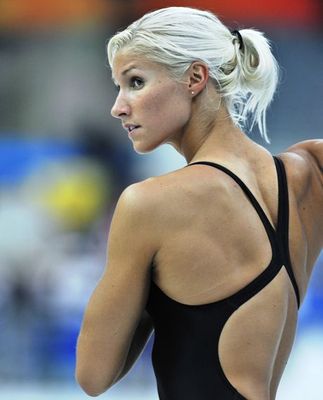
Finland's Hanna-Maria Seppala
2. The Hottie. I apologize for my chauvinism, but if there’s a women’s event on and there isn’t a U.S. competitor, I’m rooting for the most attractive one in the field. If there are any women reading this, I will not fault you for doing the reverse. 

Most of these competitors are not rich and famous celebrities like the athletes we watch day in and day out. As a result, there’s a tiny part of my brain that says, 'Hey she’s not much different than me! A world class athlete sure, but she probably dates her fair share of regular Joes.' It’s one in a million, but if there’s a chance (in my mind), I've got to root for her, just so we’d have something to talk about over dinner. 

3. The English Speaking Nation. I have to support the fellowship of the countries that share our language: Great Britain, Ireland, Australia, New Zealand, etc. We share a similar cultural heritage, and besides, we’ve been kicking/saving England’s butt since 1776 so we should throw them a bone and throw our weight behind them once in a while. 

4. Not China. This used to be Not the Soviets/ Russians, but now that the communist propaganda-fueled PED binges have ceased, the Russians just don’t compete with us in much besides gymnastics and hockey. 

So instead, we must turn to rooting against the latest insane communist dictatorship that pumps its athletes full of drugs (sorry, allegedly) and brainwashes them into robots in an all-out attempt to validate their way of life. That's China. When I watch the diving, where the Chinese are nearly flawless, it pisses me off. When I see their “of age” gymnast, I’m disgusted. When their 16-year-old IMer splits faster than one of the best male swimmers in the world, I question their purity. Every hero needs a villain, and China is our new arch-nemesis. 

Iceland's Olafur Stefansson
5) The Feel-Good Story. Often, before an event where no one knows the name of a single participant, NBC or its announcers will tell us a tear-jerker of a story about how one competitor overcame the odds to make it there, or beat tragedy, or is doing this for some cause greater than him/herself. If all else fails, root for this athlete. 

The great thing about the Olympics is watching someone’s dreams come true in front of the entire world. That joyful moment when an athlete achieves what he or she has worked so hard to accomplish is so pure and raw and uplifting. It’s really what sports are all about and cuts to the core of our collective human experience: To root for the first woman athlete from Afghanistan in her 100 meter dash, to root for a 71-year-old Japanese equestrian, to root for a French canoer derailed by bad luck last four years ago. Uniting the world through sports is the spirit of the Games. So when you do get a chance, root for the story, buy in to the international side and be a part of something that transcends borders. 

Matt Anderson is Began in '96's Richmond correspondent. He also writes about sports here, when he's not keeping track of the bro-est Olympians on the planet.
Read more »

SPAIN WINS: A record-smashing Euro 2012 performance

July 1, 2012 1 comments

By Matt Anderson

Spain's dominating Euro 2012 win confirmed that we've witnessed the greatest international football team ever.

I need to preface this piece with an admission of bias: As an ardent supporter of FC Barcelona, I am a huge Spain fan, since most of Barca’s players play for La Roja. That being said, and understanding the impulse to anoint everything in our lifetime the “greatest ever,” we have just witnessed the greatest international football squad ever. Spain just won its second straight European Championship, sandwiching a World Cup title in between for good measure. No team before them has repeated as Euro champions, or won three straight major tournaments.

In truth, Spain have been the best in the world since 2008, toppling many records along the way. No team has scored on them in a knockout round since France at the 2006 World Cup (more than 16 hours of football, for those keeping track). After allowing a goal against Italy in the opening match of this tournament, they didn’t concede again, shattering not only the record for scoreless minutes played (well over 500), but also record for fewest goals allowed in the Euro Championship (formerly 3, now 1).

Contrary to popular belief, Spain get it done at the offensive end as well. Fernando Torres won the Golden Boot with three goals and one assist, benefiting from the tiebreaker of fewest minutes played to snatch the top-scorer title away from from Germany’s Mario Gomez. And as a team, La Roja were ruthless in pulling apart an Italian team known for its defense.

This past week was especially indicative of just how good Spain is compared to its biggest rival, Germany. In their semi-final match against Portugal, Spain faced a team determined to frustrate them by disrupting their metronome-like passing with fouls and feigned injury. Yet Spain stayed calm, persevered and found a way to win in penalties. 

Compare that performance to Germany’s against Italy. Germany controlled the game early on, while the Italians were content to revert to their old form of stout defense and opportunistic counter attacks. The tightly packed Italian defense frustrated Germany. They began to force passes, providing Italy with chances to turn the tables and go on the offensive. Italy capitalized, and won more easily than the 2-1 score might have indicated. Germany couldn’t handle things not going exactly as planned; Spain could. Spain has trophies; Germany doesn’t.

Spain displayed that ability to adapt early on in the Euro final. They surprisingly did not enjoy a majority of the possession in the first half. But instead of forcing their traditional style onto the match, they took advantage of its natural flow. Spain upped their tempo when in possession, throwing the Italian defense off-kilter, an approach that paid off when Xavi threaded an inch-perfect ball to Jordi Alba. A defender on a blazing run from deep in his own half, Alba took the pass with only keeper Gigi Buffon to beat. The finish was clinical, and provided Spain with an adequate cushion. 

The Spanish did benefit from two injuries that left Italy with 10 men for the final 30 minutes, but by then they had long outclassed their opponent. Their passing and movement had Italy spinning, and Spain's midfielders routinely found space by maneuvering their way out of double and triple teams. By the end, Spain had set a new record for margin of victory, thanks to final goals that looked eerily similar to their second one: perfect through balls leaving the defenders baffled and the keeper on an island. It’s as if they heard all of the critics calling them boring and used the final as a big “eff you” reminder of just how devastating their “death by a thousand passes” game can be.

In their last two games, we saw two different Spains: one with nothing going their way, one with everything going their way. It didn’t matter, the results were the same. The hallmark of a true champion is gutting out a win when things aren’t easy and punishing opponents when they are, and Spain did just that. 

The question now is how long this can continue. Historically, European teams don’t win World Cups held in South America. Yet, as this Spanish team has shown, history means nothing to them unless they are writing it.

Matt Anderson is Began in '96's Richmond correspondent. He also writes about sports here, when he's not keeping track of the bro-est Olympians on the planet.
Read more »

Euro 2012: 16 players to watch

June 8, 2012 0 comments

By Matt Anderson

A guide to the best, brightest and quirkiest players that you should keep an eye on during Euro 2012.

On June 8, the European Championships kick off across Poland and Ukraine. This competition is like the World Cup on crack. Everyone in the 16-team tournament knows each other well, and likes each other a lot less.

For those of you who aren’t soccer obsessed like me, I’ll give you one player from each team to watch and a license to use any of the following to impress people watching Euro 2012 with you.

Group A

Poland: Wojciech Szczesny, GK.
You pronounce it Woah-Check Shez-Knee. This young keeper came into his own for England’s Arsenal this year, manning the space between the sticks in their third-place campaign. He kept 18 clean sheets, which is a lot for an Arsenal team with less than stellar defense. He also made a highlight reel penalty save against Liverpool that ended up being the difference in the game.

Greece: Fanis Gekas, F.
Gekas is old. But he's crafty. He doesn’t play in the big leagues anymore, instead plying his trade in Turkey for Samsunspor. But he scored eight goals in 11 appearances for them, and if Greece wants to pull off a shocker, he’s going to need to be very active and soak up a lot of pressure.

Russia: Alan Dzagoev, M.
He’s only 21, but he’s been the Next Big Russian Thing for what feels like forever. Dzagoev is athletic and has great vision and passing skills. He also has a knack for scoring, which is helpful since Russia’s strikers have struggled of late. This tournament is his audition for a club from one of the big four leagues (England’s Premiere League, Spain’s La Liga, Italy’s Serie A, and Germany’s Bundesliga).

Czech Republic: Petr Cech, GK.
About a year ago, everyone said Cech was washed up. They said the fractured skull he suffered in 2006 had made him timid. It looked as though his days at Chelsea were over. But over the past few months, he's played at the highest level imaginable. First, he survived the barrage that was the Champions League semifinal versus FC Barcelona. Then he won Chelsea the FA Cup.  And then he saved a penalty in extra time as well as two during penalty shots to win the Champions League final. He is in the form of his life.

Group B

Netherlands: Robin van Persie, F.
Arsenal’s RVP showed the world just how good he really is this year, winning all three of England's Player of the Year awards. He scored 38 goals total, including 30 in the Premiership. As RVP went, Arsenal went, but for this deep Dutch squad, he won’t have to do all the legwork, leaving him fresher than ever.

Denmark: Christian Poulsen, M.
Poulsen is going to be critical for the Danes. He will have to cover for the back line, which boasts some decent players but few superstars. He will also have to get the ball to their front line. Poulsen is the quintessential box-to-box midfielder, and he is one of the most experienced men in this tournament. If he’s up to the task, the Danes could put up a fight in this Group of Death.

Germany: Bastain Schweinsteiger, M.
His last name is one of the most fun to say in the tournament. Schweinsteiger is also is the lynchpin of the well-oiled machine that is Germany. He will be charged with defending, attacking, distributing, and otherwise making sure all the pieces swirling around him move like they're supposed to. Germany is one of the favorites to win this thing, and to do that, he'll have to play a key role.

Portugal: Cristiano Ronaldo, F.
There are few players in this tournament who can put their teams on their back and Cristiano Ronaldo is one of them. But that’s the problem: In the past he has tried to do that and failed miserably. When things don’t go his way, he checks out and becomes rather petulant. However, if he can strike the perfect balance between taking over and letting the game come to him, Portugal could turn a few heads.

Group C


Spain: Xavi, M.
As Schweinsteiger is to Germany, Xavi is to Spain, but times 10. This little man is the calm in a storm of soccer magic, much like he is at FC Barcelona. He never tires and never misses a pass. He was the MVP during Spain’s run to the title in 2008, and things will be no different this time around. If Spain is a frenetic sonata, he is the metronome that keeps everything on rhythm.

Italy: Mario Balotelli, F.
Balotelli is a wild card. Earlier this year, the Manchester fire brigade had to come put out a blaze that he had started by shooting off fireworks in his bathroom. Later in the year, he followed a brilliant goal by flashing a shirt that said, “Why Always Me?” It’s always him because we don’t know what he’ll do next: slot home a goal after an amazing touch, or slide tackle an opponent who doesn’t have the ball and get sent off. He never fails to entertain, or have a terrible haircut, and Italy is putting a lot of hope on a 21-year-old who''s likely just on the wrong side of loopy.

Ireland: Robbie Keane, F.
One of the few players in this tournament who plays here in the USA. He led the Galaxy to an MLS title last year, but did it with what seemed like three-quarter effort. He's in the twilight of his career, yet Keane can nevertheless make an impact. Keep in mind that he holds the distinction as Ireland’s career goal-scoring leader.

Croatia: Luka Modric, M.
Modric is one of the most creative and driven midfielders in the world. Last summer, Tottenham fought hard to keep him away from many suitors, including super-rich Chelsea. One can only imagine that he’s still looking to move, now that the Spurs failed qualify for the Champions League. Modric disappeared at the end of the year for Tottenham and will be looking to show everyone that that was an anomaly, not the new norm.

Group D

Ukraine: Andriy Shevchenko, F.
Shevchenko has been around the block quite a few times. He knows his history and he knows how important this tournament is to Ukraine. With the home crowd behind him, he will look to reach back to the mid aughts and find a rich vein of talent to help his team impress in a relatively wide-open group.

Sweden: Zlatan Ibrahimovic, F.
Ibra was once a lumbering target who struggled when he didn’t have good service from the midfield. Then he went to AC Milan, where he grew into what experts call the false nine role. Ibrahimovic can now sit in a sort of no-man’s land between where a striker normally would be and the midfield, and drive the action forward as well as score on his own. His passing is spot on and his finishing is often creative and exciting.

France: Hatem Ben Arfa, M.
This relatively young player has had a rough couple of years. His lack of discipline and health has kept him out of regular action, but this year with Newcastle he still managed to hit a new level in his development. Gven a chance to get a consistent run of games, Ben Arfa produced some magical goals. He will look to continue that this summer and restore France’s disgraced name.

England: Andy Carroll, F.
For much of the year, Andy Carroll was Liverpool’s waste of 35 million pounds. This lolloping forward struggled to stay with the squad and struggled to score. But toward the end of the year, something clicked and he suddenly became a threat to score. In the FA Cup final in May, Carrol came off the bench and immediately halved the deficit, then appeared to tie it when his header was saved into the underside of the crossbar. We’ll probably never know if it was in, but the man is playing with confidence, and that will go a long way. Carroll's even more important for England  this year, because Wayne Rooney must sit out the first two games due to disciplinary problems. If he continues to play well, England should be in good position when Rooney returns.

Matt Anderson is Began in '96's Richmond correspondent. More of his coverage of Euro 2012 can be found here.
Read more »

Dangerous waters

May 25, 2012 4 comments

By Matt Anderson

The penalties for the Redskins and Cowboys are just the latest in the string of heads I win, tails you lose mandates that have come to characterize the Goodell administration.

The NFL wins yet again.

On May 22, an arbitrator upheld the NFL’s penalties on the Washington Redskins and Dallas Cowboys for overspending in 2010. The crazy thing is that 2010 was an uncapped year. So how can a team spend too much when there’s no limit on how much they can spend?

This is just the latest instance of Roger Goodell/the NFL running roughshod over its players to get what it wants. It started with the new collective bargaining agreement. It included making the New Orleans Saints the whipping boy for a bounty system that, judging by the reaction of many players, exists in some form throughout the league. Now, teams are getting hit with cap penalties for violating a non-existent cap.

When Roger Goodell took over as commissioner in 2006, he brought a hard-nosed approach to a hard-nosed game. His predecessor had believed there was value in working with the players who gave so much to the sport. But whether it was a conscious choice, or prompted by owners who saw the opportunity to grab more power, Goodell took a decidedly different approach: one of pro-management inflexibility. The overarching theme was that Goodell knows best and you will get no say in the matter.

Early on, this attitude worked. Fans were tired of characters like Pacman Jones and Plaxico Burress. Facing the potential for an “NBA problem”* he instituted an authoritarian regime that suppressed individual expression and clamped down on players' off-field conduct. His punishments were as harsh as they were arbitrary, and all were final. The concept of due process had no place in the NFL.

*By NBA Problem, I mean the challenge of selling a sport dominated by minorities to white America. It’s harsh and unfortunate, but a reality. There's still a healthy contingent who won't watch the NBA because it's populated by "a bunch of thugs.”

Where the waters became choppy for this all-powerful administration was when concussions moved to the forefront. Two seasons ago, Goodell had unilaterally changed the rules of football in response to the public’s growing concern about head injuries. It was the right thing to do, even if the abrupt way he did it rubbed some the wrong way.

But then, Goodell continued his push for an 18-game season, or what would amount to two more full-speed opportunities for players to suffer concussions. At the same time that he expanded the league’s power under the guise of protecting players, Goodell was also trying to expand the league’s power by playing the other side of the issue. It became clear that Goodell’s decisions weren’t made for the public good, but for the good of the NFL, at the expense of everyone else.

The events of the last 10 months have confirmed that one side of the table still holds all of the control. The League locked the players out. The League dictated the terms of the owner-friendly CBA, and then it made an example out of the Saints. The League is now punishing the Redskins and Cowboys “in the name of competitive fairness.”**

** By the way, the Redskins and Cowboys are really tearing up the NFL these days. Three combined playoff wins in the last 15 years. Good thing Goodell stepped in to punish them.

Right now, the NFL can afford to operate this way. Football is the most popular sport in the U.S., and the professional game has become ingrained in our culture. But nobody likes a bully, and the NFL is moving toward becoming the biggest bully in sports. Whether it’s a slow, headline-driven erosion of public support or one drastic miscalculation, Goodell’s heavy hand will eventually spark a backlash. Sports are built on the concept of competition within the framework of fairness, equality and justice. A league that operates contrary to that can only survive for so long.

Matt Anderson is Began in '96's Richmond correspondent.
Read more »
Related Posts Plugin for WordPress, Blogger...

About the site

Began in '96 features perspectives on sports and their place in the wider world. Each piece aims to move beyond easy cynicism or blind reverence and instead deliver thoughtful and incisive viewpoints that drive the conversation forward.
There are four regular contributors to the site, and comments, questions and corrections can be sent here. Follow Began in '96 on Twitter here.