Content

Showing posts with label Joe Schackman. Show all posts

Second to None

March 4, 2013 0 comments
http://bleedingyankeeblue.blogspot.com/2011/08/why-phil-hughes-is-on-mission.html
By Joe Schackman

Robinson Cano will be a free agent in 2014. So how big is that contract going to be?
Robinson Cano is in new territory. There have been 42 $100+ million contracts in MLB history, and excluding relief pitchers, they’ve covered every position on the diamond. Except second base. Seventeen to infielders, 12 to outfielders and 10 to starting pitchers. A distinguished list that doesn’t include any second basemen.

The closest so far was Ian Kinsler and his $75 million deal. But that will all change with Robinson Cano. Whether the Yankee star breaks the nine-digit mark isn’t a question. He almost certainly will, and could even become the fifth player to reach $200 million. But a negotiation for that much money is never simple, and even as the highest-paid second baseman ever, there could still remain a large gap between what Cano is worth and what he ends up earning.

Cano is, at the most basic level, an elite ballplayer. He’s a good fielder and more than capable hitter, slugging more 25 home runs in four of his six full major league seasons and peaking last year with a career-high 33. The rare power hitter with a great ability to make consistent contact, Cano finished in the American League’s top 10 in hits nearly every year since 2007 and ranked sixth in on-base percentege in ‘10 and ‘12. He’s got one of those smooth, sweeping left-handed swings tailor-made for Yankee Stadium’s short porch, but away from home is just as effective at targeting the outfield gaps. And on defense, Cano’s athleticism often makes up for any deficiencies. Though some advanced stats are not kind (a career -30.6 UZR from Fangraphs, mostly coming from his first 132 games as a major leaguer), he possesses the necessary range and arm for the right side of the infield. But what stands out the most is his sheer gracefulness; Cano seems to glide to every ball, the kind of casual speed normally reserved for outfielders.

All of that adds up to a player who, statistically, was one of the league’s best over the last few years. Cano’s 29.5 fWAR since 2007 is the ninth-best in the MLB and third among second baseman. Over the last three seasons, only Miguel Cabrera and Joey Votto compare with him on an fWAR basis, putting Cano in line for a major payday.

But then the question is, how big can that payday get? To get an idea, we should first start with what his past play tells us about Cano’s future value. Fangraphs projects a 5.3 WAR season in 2013 for the second baseman. Using Tom Tango’s philosophy on aging and play quality, we can assume that Cano will lose about 0.5 WAR per year in his 30s. The last element to consider is the market rate for a win, which is currently about $5.5 million. Putting those together, that means a 5.3 WAR season for Cano would be worth nearly $28 million to the Yankees, far more than the $15 million they’ve already agreed to pay him for this upcoming season.

So before we try to predict the future, let’s throw in one more assumption: a 6% inflation annual rate on that $5.5 million worth of a win. With all that, here’s how Cano’s next nine years project:


Length
Year
Age
WAR
$/W
Salary
Total Value
1
2014
31
4.8
$  5,830,000
$  27,984,000
$    27,984,000
2
2015
32
4.3
$  6,179,800
$  26,573,140
$    54,557,140
3
2016
33
3.6
$  6,550,588
$  23,582,117
$    78,139,257
4
2017
34
2.9
$  6,943,623
$  20,136,508
$    98,275,764
5
2018
35
2.2
$  7,360,241
$  16,192,529
$  114,468,294
6
2019
36
1.5
$  7,801,855
$  11,702,783
$  126,171,076
7
2020
37
0.8
$  8,269,966
$    6,615,973
$  132,787,050
8
2021
38
0.1
$  8,766,164
$    876,616
$  133,663,666

That’s just over $130 million in total value. Which is funny, because all signs point to him seeking nothing less than $200 million over that same period. It’s pretty obvious which side will end up getting the better deal here. But that’s the price of doing business in the modern market. Teams are becoming smarter about locking up premier players before they hit free agency, and the clear message is that if you want the best, you’re going to have to pony up. Despite the statistical evidence, Cano’s closest benchmark is likely the 10-year, $214-million megacontract given to Prince Fielder last year. That deal factors in a $24 million annual average value, and applying that to Cano would put him right around $200 million over eight years.

It will now be the Yankees’ job to negotiate that down as far as they can without losing him for good. New York is in an uncharacteristically frugal era, trying to keep their annual payroll under $189 million so as to avoid luxury tax penalties that could cost the team as much as $70 million. That goal is within striking distance, especially with just three players under contract through 2014 (CC Sabathia, Alex Rodriguez and Mark Teixeira). Adding Cano to that roster would take up a chunk of space, but is nevertheless doable. And while this might not be the win-at-all-costs Steinbrenner team of the ‘90s and 2000s, his sons have been upfront about wanting to franchise their star infielder. The odds are that the Yankees end up retaining Cano, though nothing is guaranteed until the contract is signed. Well, one thing is. Robinson Cano is going to get paid.

Joe Schackman is a co-founder of Began in '96.
Read more »

Bourn Free

February 6, 2013 3 comments
www.amazinavenue.com
By Joe Schackman

Why is Michael Bourn still sitting at home? It has something to do with his agent.

Scott Boras is likely the first person that comes to mind when you think of a sports agent. And with good reason; he’s built his reputation on helping the some best baseball players in the world ink some of the biggest contracts in history. Of the four $200 million deals ever signed in Major League Baseball, Boras had a hand in three of them. He’s a super agent.

But even a super agent fails sometimes, and Michael Bourn is in the middle of finding that out.

Any conversation about Bourn’s lengthy free agency has to include Boras, because Boras is the main reason that the former Atlanta Braves outfielder is still sitting at home. It’s clear that Bourn still has the kind of talent coveted by big-league teams. He was ranked among the top three defenders by both Baseball Reference and Fangraphs at a premium position, and is a potent leadoff hitter at the plate. What he lacks in power (a career-high nine in 2012), he makes up for with a decent walk rate and excellent speed on the basepaths. As an overall offensive package, he’s a solid addition to any lineup. Couple that with his best-in-show defense, and you have a player consistently putting up 4+ WAR seasons. The stats all say the same thing: Michael Bourn is a very good baseball player.

So in a market that shelled out $125 million for Josh Hamilton and $75 million for B.J. Upton, why is the best player available still without a home?

Part of the answer is that teams are worried about investing in a player whose talents might not age so well. As Dave Cameron detailed a few weeks ago at Fangraphs, players who excel defensively from from ages 18 to 29 tend to drop off significantly after they hit 30. Andruw Jones, Carl Crawford and Aaron Rowand are each recent cautionary tales. With so much of Bourn’s value wrapped in outfield range that could quickly diminish, there could be some hesitation in giving him a lengthy and potentially bloated contract.

Then, of course, there’s the Boras factor. He’s notorious for extracting big-money contracts for players that at times haven’t panned out as expected, and as a result teams have learned to think twice before jumping into bed with him. With Bourn, he’s used his traditional method of dangling his client on the open market far longer than any other top player. The advantage is that there is no disputing that Bourn is the best one available. But in the meantime, the demand for him has shrunk. The Nationals, A’s, Braves, Red Sox and Angels all addressed their needs with other players through free agency or a trade while Boras was driving a hard bargain.

Bourn will play somewhere next year, though, even if it takes him longer than he’d like. The Mets would make the most sense given their current outfield personnel, which is the worst in the league. Lucas Duda is a horrible defender, center field is a platoon between Kirk Nieuwenhuis and newcomer Colin Cowgill, and Mike Baxter and Andrew Brown are battling it out in right field. Bourn would give them one legitimate everyday outfielder, and help them cover Citi Field’s cavernous confines. But there are some major obstacles. New York is still mired in its messy financial situation, and signing Type-A free agent Bourn would mean forfeiting their top draft pick. Though the Mets were the 10th-worst team in the league last year, they’re picking 11th because the Pirates couldn’t sign their first rounder from last year. That means the typical protections for top-10 picks don’t apply to New York, unless the MLB grants them an exception. Should Bud Selig rule in their favor, they could be a good bet to end up with Bourn. Without that, though, it seems unlikely.

If not the Mets, the Mariners and Rangers are the top contenders. Seattle has flirted with outfielders this entire offseason, from their Josh Hamilton pipe dream to a legitimate courtship of Nick Swisher that ended when he signed with Cleveland. Adding Bourn would instantly infuse them with much-needed talent. But like the Mets, it would mean giving up a relatively high first-round pick (No. 12). They’ve also been burned in the past by a poorly aging defensive wonder. After watching Chone Figgins and his four-year, $36 million deal flame out, they might not be too eager to pony up the cash again.

Texas also has a hole at center field after Hamilton’s departure, and has also missed on just about every free agent and trade prospect so far this offseason. Bourn would mitigate that issue, especially with Nelson Cruz facing a 50-game suspension. But in the Rangers’ hitter-friendly ballpark, his defensive value would also be somewhat limited. They might instead opt to give homegrown Leonys Martin a shot at the job, rather than commit to a long-term contract.

Outside of those three, it looks bleak for the last remaining big talent. Though Prince Fielder played a similar role of odd man out last year and got a nine-year, $214 million deal, that only came after Victor Martinez tore his ACL and the Tigers found themselves with an unexpected hole to fill. And don’t forget, Fielder signed his contract on Jan. 26. We’re now into early February.

If all else fails, Bourn could always take a one-year deal and reset his market next year. That would bring a lot of teams back into the mix, including the Yankees and Phillies. It’s always a risk though, especially after coming off a career year. As hard as it might be to believe, Bourn’s value might never be higher than it is now, and the super agent Boras might have overplayed his hand.

Joe Schackman is a co-founder of Began in '96
Read more »

2012's Best: Linsanity

January 15, 2013 2 comments
Via The Knicks Wall
By Joe Schackman

The year that Jeremy Lin captivated a nation and brought one lapsed Knicks fan back into the fold. Part of a short series on the best moments of 2012.

2012 A.D. taught me one important lesson. I’m a shitty Knicks fan.

During the most recent dark age of the storied New York franchise, I was nowhere to be found. Isiah Thomas was busy stuffing his roster with the likes of Stephon Marbury, Steve Francis and Zach Randolph, and I was busy doing... well... other things. The Knicks were lifeless, rudderless and couldn’t get out of their own way. I was in no mood to go along for that ride. Sorry, New York, but things were complicated. It was me, not you.

Yet lo and behold, the orange and blue eventually found their way back into my life. First Amar’e came to town, and that piqued my interest. Then the excitement grew when Melo arrived home. But the one who finally convinced me to give it another go was not one of the Knicks’ superstars. It was a slightly awkward, couch-dwelling kid named Jeremy Lin.

At least half the adjectives in the English language have been slapped onto Linsanity, but none have stuck. It’s still a hard concept to express in words. I mean, really think about what happened. A 23-year-old Asian American, Ivy League grad, who even the biggest basketball diehards had never heard of, suddenly finds himself at the epicenter of the sports world. Look at his resume and you’d think he had a better chance of owning an NBA team than running its offense. And yet here he was.

And there I was, in at the ground level, having casually turned on the February Knicks-Nets game that would put Lin on the map. He carried the team, scoring 25 en route to a win. Then in his first professional start he scored 28 against the Jazz. He was must-see TV, and I was giving a crap again. Rushing home to watch games. Yelling about how Lin defied all of sports’ truisms. He was a throwback to the time when some anonymous young kid could stumble off the farm with a 95-mile-per-hour fastball and a ticket to the Majors. Lin was the kind of out-of-nowhere star that you simply don’t see anymore, and because of that, I cared whether the Knicks won or lost for the first time in a long time.

The hyperbole surrounding Lin’s play was intense, of course. Everyone knew that what he was doing was unsustainable. But at the same time, his success wasn’t all smoke and mirrors. You don’t fall ass backwards into 38 points against Kobe and the Lakers. You don’t hit a game-winning, buzzer-beating shot against the Raptors. Not if you don’t have some serious chops. Lin played the best ball of his life, yes, but he did it long enough to prove he belonged.

Then came the injury, the early playoff exit and then the off-season move to the Rockets. I was crushed. I’d grown attached to the Lin-led Knicks, and it didn’t matter what it took to keep that going. I could justify the cap hits and wish away Jim Dolan’s money like it was nothing. The men in charge saw it differently. Soon Lin was packing his bags.

As 2012 turned to 2013, the Knicks showed that they are better than ever. Their play is still infectious, but without Lin it hasn’t been the same for me. Maybe it never will. Maybe I’ll always look back at 2012 as the year that set the bar too high, that haunts my fandom.

Or maybe I’ll just stop caring about the Knicks again. It worked the first time.

Joe Schackman is an editor and co-founder of Began in '96.
Read more »

Tebow to Jets: 'I quit.'

December 26, 2012 0 comments
Via Barstool
By Joe Schackman

Tim Tebow: Heisman Trophy winner, first-round draft pick, media darling, and now, quitter.

Sadly, a simple Google search of “Jets player quits” yields more results than any fan could ever hope to see.

There are articles on Fireman Ed’s public resignation, the October pummelling at the hands of the 49ers, and of course, Santonio Holmes’ meltdown in week 17 of last year. Surely you remember that one: with a winning season, playoff spot and pride on the line, Holmes felt it necessary to fight with teammates in the huddle. He was benched that day, and pilloried in the press for the next week. The incident became the symbol of the Jets’ broader locker room dysfunction.

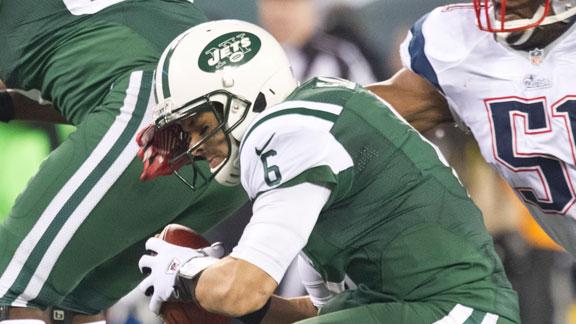
One year later, and that dysfunction is back in the form of another quitter: Tim Tebow. To be clear, the Jets have been a mess this entire season. They were mathematically knocked out of playoff contention last week against the then 4-9 Titans, though that was just a formality. They were never really “in contention.” But any hope that the team might just slink away and start their offseason planning evaporated once the Jets benched Mark Sanchez for rookie Greg McElroy, passing over their second-stringer/media lightning rod in the process. Infuriated, Tebow reportedly told coaches that he would not participate that week in the Wildcat play package designed especially for him. Translation: I quit.

Now, you could argue that Tebow never got a fair shot with the Jets. He joined the team after a high-profile recruiting process during which many promises were likely made. He hasn’t come close to starting a game since then, despite playing the furthest into January of any Jets quarterback last year. And how the team has handled his role — dressing him when injured with broken ribs, scratching him when healthy — must make as little sense to Tebow as it has to the rest of us. But while that might make you upset, it doesn’t excuse wholesale quitting.

After all, what about Tebow’s play this season demonstrated that he deserved a starting shot? He played more than 70 snaps this year, mostly as the focal point, and at no point did one of those plays make you sit up and pay attention. In an offense desperate for an explosive playmaker, Tebow was not the answer.

Even last year, amid the frenzy over his six straight wins, warning signs abounded. He rarely hit his target, took too many sacks and fumbled 14 times. That was with the benefit of a stalwart offensive line, talented receivers and one of the NFL’s best defenses. Imagine him now with one of the league’s worst receiving corps, a nonexistent running game and a line that surrendered 11 sacks last week. Or if all that carnage is too much to picture, stick with this year’s small sample size: a 20% sack rate, 4.9 yards per pass attempt and 3.2 yards per rush. Tethering Tebow to the bench could be personal, especially if reports of infighting with Rex Ryan and offensive coordinator Tony Sparano are true. But with their jobs on the line, there is little doubt that they also see on-field justifications for their decision.

Tebow disagrees, and that’s understandable. He’s competitive and came to New York to play. Somewhere along the way, though, that competitiveness turned into entitlement. The player that preached sacrifice and “doing whatever it takes” for the team ignored his own sermons and opted out of his obligations. Throughout Tebow’s whole career, the game has adapted to him. His Senior Bowl team installed elements of Florida’s game plan to ensure he could show off his skills. The Broncos started him over second-stringer Brady Quinn (meaning Tebow did the same thing to Quinn that McElroy has now done to Tebow), then simplified their approach and limited his throws to ensure maximum success. In the offseason, they gave Tebow full control over his next destination. The Jets in turn preserved a play package just for him.

Now for the first time, a team is refusing to go the extra yard. New York owes him nothing but a paycheck, and in response Tebow shut himself down. He’s not “standing up to Rex,” or giving the Jets what they deserve, despite what some might argue. In a league where players are criticized for lesser offenses like holding out in the offseason or retiring early, the fetish-like obsession with this backup quarterback cannot gloss over his actions. By refusing to play in the Wildcat, he’s provided some insight into his true character. Tebow might be a competitor, but he’s also a quitter.

There is one game left in the season. It’s doubtful that Tebow will return. The team-first guy that he is, he already demanded a trade or release. The likely next destination is Jacksonville, another place willing to adapt to his needs. Returned to the comforts of hero worship, Tebow might not quit on them. But he deserves to be labeled, along with Santonio Holmes and all those before him, as one who might.

And about that Wildcat package that Tebow deemed beneath him? It was at its most effective all year with wide receiver Jeremy Kerley running the show. Hope the Jaguars include that in their scouting report.

Joe Schackman is an editor and co-founder of Began in '96.
Read more »

RGIII's one-season revolution

December 12, 2012 1 comments
The Wall Street Journal
By Joe Schackman

Robert Griffin III's unique skills have changed the game's dynamics. But is it a temporary blip or a permanent evolution?

Jon Gruden was half right when he said that Robert Griffin III has revolutionized quarterback play in the National Football League.

The dynamic rookie is perhaps the only one alive who could run a pistol offense with consistent success, toggling between the array of passes, handoffs and scrambles presented to him at every snap. He’s confounded defenses and added a new layer of complexity to the position, and for that he has surely changed the game. In the NFL, though, change is as fleeting as it is common. The true test of the RGIII revolution is whether it sticks around.

As unique an athlete as the ‘Skins quarterback is, his singular effect on the league is not a new story. When teams find a player with a special skill set, they have always tried to maximize their impact by innovating around them. Often that means looking to the past, plucking decades-old game plans and inserting them into the present.

We saw that in 2008, when the Miami Dolphins wanted to get running backs Ricky Williams and Ronnie Brown involved at the same time. Coach Tony Sparano found his solution in the early 1900s, adapting the Pop Warner-designed single wing offense to the needs and realities of the pro game. By opening day, it had been rechristened as the Wildcat and looked nearly identical to some formations being run in college football.

The Wildcat steamrolled across the NFL that season. Miami won 10 games and the AFC East title, and a so-called revolution was born. By the next year, half the league had developed its own take on the formation. But despite its initial success, there was a reason the Wildcat had become extinct in the NFL all those decades ago. Defenses were simply too fast to cover the obvious running plays engineered out of the formation, and once the surprise factor wore off they simply pinned their ears back and gunned for the ball carrier. The Dolphins followed their ‘08 season with back-to-back 7-9 years, and Sparano was soon out of a job. The Wildcat followed, and at this point is an afterthought slotted firmly into a few teams’ trick play category.

It’s hard not to think back to that short-lived period when watching Griffin run the pistol. He’s a dynamic quarterback with a big arm and wide receiver-type speed. Yet even with such distinct talents, we’ve seen this before, going back to Michael Vick and Donovan McNabb and even Kordell Stewart. Griffin could prove better than all of them, but he is still built from the same dual-threat mold.

Where he diverges significantly is the offensive package he’s charged with running. Rather than cram him into a traditional system, Washington adopted the shotgun/single-back hybrid called the pistol. Used by some college teams, it places the quarterback halfway between the center and the running back, ideally allowing the quarterback to read the defense while also giving him an extra second to get a pass off. San Francisco starter Colin Kaepernick ran it effectively during his time at the University of Nevada, and Missouri, LSU, Ohio State and UCLA are among the others that have featured the formation. Some NFL teams have played around with it as well, mostly as a change of pace. But it had never been a primary formation before the Redskins dialed it up.

So far, it’s hard to argue with Washington’s success. On Monday Night Football against the New York Giants, the ‘Skins ran 32 of their 52 plays out of the pistol. It gave them multiple options, opening holes inside for running back Alfred Morris, outside for Griffin, and giving the receivers time to get open for the deep pass. The Giants looked lost against it.

Washington found similar success the next week against the Ravens, and for that reason the pistol is suddenly seen as the next big thing for the NFL. Expect more teams to adopt it and tailor the formation to fit their own strengths, and maybe even reap the rewards for a few weeks.

The lessons of the Wildcat loom large, however. Defenses often need time to adjust to new offensive gimmicks, but when they do, they stop them cold. There’s little doubt coordinators are spending day and night dissecting the pistol. For teams adopting the ‘Skins scheme, it’s likely a matter of time before they’re forced to return to a more traditional game plan.

Time could soon be up for Washington as well. The smart bet is that the novelty will wear off and the team will find itself going the way of the Dolphins if they fail to innovate further. But no one else has a centerpiece like Griffin, and it remains to be seen just how powerful a variable he is. For now, he’s simply changed offensive football in the NFL. Determining whether it’s a full-fledged revolution will take a bit more time.

Joe Schackman is an editor and co-founder of Began in '96.
Read more »

The Jets' lost season

November 29, 2012 0 comments
By Joe Schackman

Three-quarters of the way through the season, it's clear that the New York Jets have quit.

Let’s start by getting this out in the open: the Jets are a terrible football team. They have a head coach struggling to reinvent himself; a general manager who left the roster full of glaring gaps; a defense so blinded by its hype that it’s run smack into a harsh reality; and of course two quarterbacks at the rock bottom of their short careers.

It’s not just that the Jets are bad, though. A lot of teams are bad, and New York fans have witnessed their fair share of them. It’s that these Jets are bad and show no inclination to do anything about it. They’re floating toward season’s end, lifeless.

The issues start at the top, with quarterback Mark Sanchez. Anointed as the franchise’s savior before he ever took a snap, the former fifth overall pick rode a strong defense and powerful running game to back-to-back AFC championship games, and looked as if he might turn into a real life NFL signal caller.

Just two years removed from that success, he’s far from the Jets’ dream quarterback. The team went 8-8 after elevating him from game manager to offensive centerpiece, and since then he’s only backpedaled faster. Burdened this year by the criticism and finger pointing that accompanies a poor season, and with a dash of Tebow hysteria thrown in, Sanchez is as confused as ever. He no longer mopes on the field, thanks to the body language coach hired especially for him a few years back, but instead seems to have swung clear in the other direction. Mistakes elicit little reaction, and he appears stuck in a state of detachment. Sanchez has shown enough flashes of raw ability to prove that he could become a good quarterback. The unfortunate question is now how badly he wants to fulfill that promise.

It’s impossible to tell whether Sanchez’s attitude has dragged down the rest of the team, or vice versa. But the bottom line is that the team is wholly uninspired, and that’s losing them games in spite of their talent. There are all-pro linemen and first-round picks scattered throughout the defense, and the Jets swore earlier in the season that they had fixed their locker room issues. It’s difficult to believe that though, especially when divisive figures like Santonio Holmes and Bart Scott are still around. Once the Jets lost leader Darrelle Revis to injury, it’s not hard to imagine that the general atmosphere deteriorated fast.

The on-field results, unsurprisingly, have been embarrassing. New York was blown out by the 49ers, Patriots and Dolphins. After the loss to San Francisco, cornerback Carlos Rodgers accused the Jets’ defense of quitting in what was more a statement of the obvious than a scandalous accusation. Respectable performances against the Texans, Colts and Rams have only reinforced that sentiment, demonstrating how well New York can play when it puts in the most basic levels of effort.

The Jets are badly in need of a change, and we will likely see some major personnel moves at the end of the year. But whether that translates into a better overall outlook will depend on what happens in the front office. Owner Woody Johnson is a few publicity stunts away from Dan Snyder status, just years after winning praise for his willingness to take risks on players and coach Rex Ryan. That healthy aggressiveness turned into a hunger for headlines somewhere down the line, starting with a misguided campaign for another season of Hard Knocks that was quickly upstaged by the media circus that is Tim Tebow. Johnson won the back page battle, that’s for sure. But he undermined GM Mike Tannenbaum, Ryan and Sanchez in the process, and did it for a marginal player with no clear role in the Jets’ offense (or special teams, or defense). He broke the cardinal rule of ownership: don’t meddle. Fixing the Jets means first fixing Johnson’s mindset and returning him to a more passive role where he sets a vision, hires good people and then sits back to watch it all play out.

This has been a strange era for Jets football. After two deep playoff runs, it’s hard to call it a failure. Yet calling it a success isn’t entirely truthful either. The team was always loud, often obnoxious and truly thought it was much better than it was. When the Jets were winning, that was acceptable. That’s not the case anymore.

Joe Schackman is an editor and co-founder of Began in '96.
Read more »

Why the Giants will win the World Series

October 24, 2012 0 comments

By Joe Schackman

Timely hitting and a future MVP candidate will propel one team to the World Series, but it's not the Tigers.

[ALSO READ: Adam Cancryn on why the Tigers will cruise to a championship]

It’s not hard to let the narratives surrounding the Tigers dominate your view of the World Series. They have the reigning American League MVP/CY Young winner heading to the mound three times, if necessary. They have the first Triple Crown winner since 1967 in the middle of their lineup, protected by one of the game’s premier power threats. The San Francisco Giants simply can’t match that star power.

But even without a roster of well-known names, they they're still in perfect position to win this World Series. That’s because the Giants are defined by what they don’t do: make outs.

This past season, the Giants hit the least home runs in all of Major League Baseball. They 103 balls out of the park, which is 145 less than the Yankees. But it was no matter, because the Giants win in a more traditional way: by putting the ball in play and avoiding easy outs. The team ranked fifth in batting average this year, with the eighth-best on base percentage and the ninth-most at bats. They also had one of the highest contact percentages in the league, and with a team built around gap-to-gap power, rather than home-run power, they were able to take advantage of their spacious home ballpark. The result was a league-leading 57 triples.

What this all amounts to is the fact that the Giants’ offense makes the opposing defense make plays. They take control away from the pitcher and force the eight other defenders to stop them. And while it’s not glamorous, it generates a ton of offense.

That strength will help the Giants exploit the Tigers’ biggest weakness: their defense. By signing Prince Fielder, the Tigers made it clear that they had little regard for slick fielders. They moved Miguel Cabrera to third base where he was decent, but far from good. Prince Fielder was stuck at first, where he was expected to earn little of his $214 million salary with his glove. And any time Delmon Young is in left, which manager Jim Lelyand has said we will see in this series, the team's defensive quality takes a sharp turn downward. Take a look at any advanced fielding metric, and the Tigers are one of the worst in the MLB.

Now, it’s not like Justin Verlander just lobs it in there and hopes his outfielders can race under the ball. But Verlander can’t pitch every inning of the series. At some point the Tigers will have to turn to their other starters and, of course, that battered bullpen. Getting those last three outs could prove to be Detroit’s greatest challenge.

Regardless, the edge must be given to the Tigers thanks to Cabrera, no? No. There will be two soon-to-be-MVPs on the field in this series thanks to a monster season by Buster Posey. The 25-year-old catcher came off a season-ending ankle injury to play 148 games, hit .336/.408/.549 and compile an 8 fWAR, second only to rookie phenom Mike Trout. Posey’s 24 home runs accounted for nearly 24% of the total home runs hit by the Giants this entire season. If drawing walks and slashing singles doesn’t work, for the Giants they can look to Posey to blast one out of the park.

There is a fine line in the playoffs between having momentum on your side and just plain surviving. It’s still a little unclear where the Giants fall on that spectrum after having won six straight elimination games this postseason. It took a combination timely hitting, deep starting pitching and a solid bullpen to claw their way out of a hole each time. And now they have to face one of the most dangerous lineups in the game. But whether by luck, skill, or some combination of the two, the Giants have demonstrated that they have one crucial advantage: They are never an easy out.

Joe Schackman is an editor and co-founder of Began in '96.
Read more »

Carlos, I'm Sorry

October 19, 2012 1 comments

By Joe Schackman

Carlos Beltran's career as a Met has been overshadowed by one at-bat. For that, I am sorry.

Few moments in my life as a sports fan have been lower than the last out of the 2006 National League Championship Series. Specifically, Carlos Beltran’s strike three looking that sent the St. Louis Cardinals to the World Series and knocked the Mets out of the playoffs. The Cardinals went on to win the championship that year, won it again last year and are now leading yet another assault on baseball’s top prize. The Mets haven’t been back to the playoffs since.

For most Mets fans, the image of Beltran, bat glued to his shoulder, is the only thing they remember about him. He was blamed, ridiculed and then traded by the franchise that should have instead launched him to stardom. And for all that, plus everything else, I want to say something that most Mets fans aren’t ready to: Carlos, I’m sorry.

When Beltran joined the Mets, he brought with him absurdly high expectations. His contract was huge, one of just 10 $100+ million deals to that point. While since then, inflation has watered down the impact of that nine-figure mark, at the time it was a rare honor bestowed only on the league’s super elite. Fans rightfully expected a lot from their new center fielder. The problem is that they expected far more than Beltran, or perhaps any player, could ever provide.

Nevertheless, Beltran did his best to live up to the hype. Despite an okay, but not great, 2005, he still managed to cement himself as one of the best players in baseball over the first couple years of his contract. His combined WAR from ‘05 and ‘06 reached 23.7, thanks to a rare combination of power and speed that made him one of the top all-around outfielders in the MLB. He would finish fourth in MVP voting in 2006.

Of course, that legacy was washed away the moment he watched Adam Wainwright’s ninth-inning curveball fly by.

And while Beltran played extremely well again in ‘07 and ‘08, the Mets’ back-to-back collapses down the stretch overshadowed his accomplishments. Injuries hit then, and the rest of his time in a Mets’ jersey was seemingly spent biding his time until the team could hand him off. New York finally found a taker, trading him in 2011 for Zack Wheeler.

That change was just what Beltran needed. He played 44 games for the Giants, hitting seven homers and finishing with a .920 OPS. Then the Cardinals brought him over to fill an offensive void left by Albert Pujols. For much of this year, he looked a lot like the MVP-caliber outfielder the Mets thought they would have roaming Citi Field for years to come. And like all of the others before this year, his postseason has been fantastic. The Wainwright strikeout might be his playoff legacy, but there’s no denying that he’s one of the best post-season hitters ever.

Above all else, that’s what’s so painful for me as a Mets fan. It sucked that he struck out to end the NLCS. It sucked even more that he left the bat on his shoulder the whole time. And it sucked that he couldn’t stay healthy his last few years in New York. But worse than all that is the realization that we, as Mets fans, wasted our years with Beltran.

Here we were, with the best center fielder in the game, and we not only couldn't embrace him, but we couldn't even appreciate his talent. I can criticize Yankee fans for a lot of things, but loyalty to their players is not one of them. Play well for the Bombers, and you’ll likely never be forgotten. That’s not true when it comes to the Mets and their fans.

I’m just as guilty of this as anyone else. I didn't give Beltran the respect he warranted, and I’m not even exactly sure why I now feel the need to make up for lost time. Maybe it’s because I’m watching him play, and excel, in a different uniform while the Mets wallow at home for another October. Maybe it’s because I hope that if I apologize enough, he’ll start to forgive our fan base and the team that in many ways did him so wrong. Maybe at some point in the future he’ll come back to Queens, stride to the plate with that bat that looks as long as a hockey stick, and watch the entire stadium stand and cheer. And then maybe Mets fans will earn a shot at another superstar, and this time we’ll recognize that we have something special and treat him right.

Beltran’s career is far from over. He’ll be back next year, and the year after, and maybe for a few more after that. He’ll likely move to the AL so he can take some pressure off his aging knees. But a return to the Mets probably isn't in his plans. If he someday hobbles into Cooperstown, he’ll don a Royals cap. It’ll be a painful moment, watching a man who should have been a Met forever shun my team, and wondering how different things would have been if he had just taken that bat off his shoulder.

Joe Schackman is a co-founder of Began in '96
Read more »

Giving up on the Sanchize

October 2, 2012 1 comments

By Joe Schackman

Mark Sanchez's time as a Jet is likely coming to an end, and the blame for his failures rest with both the quarterback and the team.

It’s been right in front of my eyes for the last four seasons, but until now I was unwilling to admit what everyone else saw. Mark Sanchez, the fourth-year quarterback and fifth overall pick out of USC, is not the future of the New York Jets. Until now, I made excuses for his play, citing rigged statistics and useless buzzwords like “poise” and “winner.” It’s time to face the ugly truth: The experiment, started by head coach Rex Ryan and general manager Mike Tannenbaum, is just about over. And the failures rest with both Sanchez and the organization.

In 2009, Mark Sanchez rode into New York on a wave of optimism. The Jets had a boisterous new head coach, an up-and-coming defense and, in Sanchez, a potential franchise quarterback. He would be their first top-tier signal caller since Joe Namath (though calling Namath top tier has always been a stretch) and the heart of the Jets’ resurgence.

Things have not gone as planned, to say the least. But the situation was promising for a bit. The Jets put Sanchez in positions where he could succeed, and he rode an impressive defense and solid running game to two straight AFC Championship games. It was exactly the way to handle a young quarterback. The recipe for NFL quarterback development is pretty clear cut, and the Jets followed it to a T. They limited his throws. They brought in LaDanian Tomlinson as a safety blanket. They traded for Santonio Holmes and even brought in Mark Brunel to serve as a glorified quarterbacks coach. Hell, they hired a body language coach to make sure he projected a leader’s demeanor.

But come his third season, New York asked him to take the next step, to lead the offense in a league where good passing equals wins. And that is where things went wrong.

Sanchez looked uncomfortable when asked to be “the guy.” His completion percentage was abysmal, and he was never able to keep the offense in rhythm. Though always athletic enough to make plays with his feet, once the rush got close his eyes drifted to the oncoming lineman instead of downfield, and he had a knack for throwing into double or even triple coverage. Sanchez made enough plays to keep his job, but never enough to convince the league he was a serious threat. Grantland's Bill Barnwell put his victories into the context of their strong defense and special teams and came to the conclusion that just about any quarterback could have won in his situation.

After last year's disappointing 8-8 season, the Jets brought in an offensive coordinator who specialized in the ground game, not in mentoring and developing a young quarterback within an increasingly complex offense. Then came Tim Tebow, football’s version of the Swiss army knife. It cost them a fourth round pick, and while he’s added a slight wrinkle to the offense, the deal failed fill any of their holes. In particular, the glaring one at wide receiver.

To call the Jets’ receiving corps “average” is to be extremely nice. There’s the talented but stubborn Santonio Holmes, but things get pretty bleak after that. Jeremy Kerley and Stephen Hill have shown promise, but neither is reliable or especially talented. And they’re certainly not good enough to bail out Sanchez when he needs the help.

That has seemingly become the organizational stand on Sanchez. The team publicly and I’m sure privately assures him that he is their preferred starting quarterback, but every decision they made in the last two seasons has been to his detriment. When it came time to really double down on his future, the Jets balked, walked away from the table and hoped he could do it on his own.

What’s painful about all of this is that Sanchez could still be good in this league. He showed promise at times during his young career and, in many ways, is much farther along than Alex Smith ever was. Look at Smith now, years after he was declared a bust. Even Eli Manning wasn't a stud by his fourth year, and now he’s got multiple rings. So no, Sanchez is probably not en route to a Super Bowl championship this season, but three to four years is too soon to fully judge a quarterback. But if his career to this point is any indication, it’s doubtful Sanchez will ever get what he needs from the Jets.

Assuming this season continues as it has the blame should fall on Mark Sanchez as much as Rex and Tannenbaum. This off-season could mark a complete overhaul of the New York Jets. Ownership could very well bring in a new head coach, a new general manager and that almost always means a new quarterback.

Joe Schackman is a co-founder of Began in '96 and doesn't think Tim Tebow is the answer either.
Read more »

Harbaugh's Rejects

September 18, 2012 0 comments
Credit: Stan DeVaughn
By Joe Schackman

Just two-and-a-half minutes into Sunday night’s game against Lions, while most fans were still findin their seats, Alex Smith was leading his offense down the field. On first and 10 at Detroit’s 21-yard line, he stepped to the line with two plays ready. One was his primary play; the other, a backup to turn to based on the defensive alignment. After scanning the Lions’ front four, he stepped back and yelled, “Kill, Kill, Kill!” The signal for plan B. Smith then took the snap and lofted a gorgeous 21-yard touchdown pass to tight end Vernon Davis.

There’s no single statistic that quantifies the effectiveness of a head coach’s game planning ability, roster construction or motivational tactics. There’s no way to tell how much of the success or failure should fall on the shoulders of the guy in the headset. But even without that, it’s pretty easy to see just how drastically Jim Harbaugh has transformed the San Francisco 49ers.

Perhaps the most startling aspect of the Niners’ newfound dominance is that Harbaugh is leading the charge with other coaches’ players. Alex Smith, Vernon Davis, Michael Crabtree, Justin Smith, Patrick Willis, Frank Gore, Anthony Davis and Joe Staley are all remnants of the previous regimes. Regimes whose teams haven’t had a winning season since 2002.

Harbaugh did make some upgrades to the roster. He drafted outside linebacker Aldon Smith in the first round last year. He’s already one of the best young defenders in the league. He found Kendall Hunter in the third round, and convinced Donte Whitner to join the team as a free agent. He took chances on former first round busts Ted Ginn and Carlos Rodgers, both of whom have paid dividends.

But the fact remains that Harbaugh took on a core of other guys’ players, of serial underachievers, and turned them into a team that won 13 games, defeated the Saints in the playoffs and were a muffed punt return away from going to the Super Bowl.

The biggest beneficiary of Harbaugh’s coaching is quarterback Alex Smith. Picked ahead of Aaron Rodgers after a great career at Utah, he disappointed almost immediately. His play was never bad enough to warrant cutting him (and more importantly, eating a huge contract), but it was never good enough to instill any type of confidence in his abilities. He simply hung around, churning through head coaches and coordinators at an alarming rate.

Harbaugh changed all that. He made Smith’s comfort a priority, installing a conservative offense focused on just not making mistakes. Throw a dump pass on 3rd down, punt and live to fight another day. It wasn’t flashy, but it bolstered Smith’s confidence. And by the time San Francisco reached the divisional round, he was ready for his breakout performance.

Now, with an entire offseason under Harbaugh, the 49ers have defeated two of the NFC’s best. Newcomers Randy Moss, Mario Manningham and A.J. Jenkins are there to help speed Smith’s development, while that pre-Harbaugh core provides steadiness on either side of the ball. What was once a sorry group of what-ifs and coulda-beens could now be the top team in the league.

It’s impossible to know how much of a role Harbaugh played, or what kind of impact any coach has on their respective team. Would Bill Belichick and Tom Coughlin have multiple championships if their quarterbacks weren’t on the path to Canton? It’s football’s version of the chicken or the egg. But in lieu of the perfect stat, there’s at least one measurement that gives us a good idea of Harbaugh’s influence: 2-0.

Joe Schackman is an editor and co-founder of Began in '96.
Read more »

Drawing Level: Dempsey's New Digs

September 6, 2012 0 comments


Scott Heavey/Getty Images

By Joe Schackman

Better news off the pitch than on it for the Spurs over the last few weeks.

I’m three full weeks into the Drawing Level experiment and so far I’ve noticed two things. Premier League soccer is on way too early on Saturday mornings, and oh yeah: The Spurs kind of suck.

Is three games into my fandom too soon to be pissed off? Probably. But after spending years rooting for the Mets, Jets and Knicks, it’s hard to suppress that sense of impending doom. Especially when Tottenham has the same maddening knack for collapsing down the stretch.

In each match, the Spurs found a new way to throw points away. Tied with Newcastle in the first, they handed the Magpies an 80-minute penalty kick that would become the game-winning score. Their subsequent performances were almost identically disappointing, marked by a goalless and mediocre first half, a go-ahead goal around the 70th minute, and then a crushing equalizer minutes before what should have been a victory. Against West Brom, the tying goal came in the 90th minute; versus Norwich City, the 85th. Sloppy play in the waning minutes deprived them of a fast start to the season.

There is reason to be hopeful, though. Clint Dempsey is joining the Spurs at White Hart Lane in a high-profile move across London. The attacking midfielder is arguably the best player on the U.S. National team and easily the best American playing abroad. He’s coming off a monster year with Fulham, and should fill the midfield void left after Tottenham sold Luka Modric to Real Madrid. He’s also a personal favorite of mine, and I can’t wait to watch Dempsey take the field for my adopted sons.

The team also grabbed their keeper of the future in Frenchman Hugo Loris (from Lyon) and replaced midfielder Rafael Van Der Vaart with Moussa Dembele (from Fulham). Dembele scored in his Spurs debut in what we can hope is a sign of things to come. Lloris looks set to back up American Brad Friedel, who turned in a strong game against Norwich.

Tottenham now just needs a top flight striker to pair with Dempsey. Emmanuel Adebayor is far removed from his best days, and from what I’ve gathered, the absence of a scorer up top is a problem that’s carried over from the last few seasons.

But it’s something to build on. I’m still very early in this new relationship with Tottenham, and I’d be crazy to think my rooting interest would make them all of the sudden play like Europe’s future champions. It would have been nice, though. Yet if the road is going to be bumpy, a few close losses will at least only endear me more and more to the team. I’ve learned that one from experience: The Mets and Jets haven’t given me a ton of positive memories, and their games can never come soon enough.

It might have just been my hangover, but each of Tottenham’s disappointing performances stung. And that’s a good sign. Even if just a little, I care. My ties to the Spurs are getting stronger.

Joe Schackman is a co-founder and editor at Began in '96. He is attempting to turn himself into a fan of European football.
Read more »

Juicing Derek Jeter

August 28, 2012 3 comments

By Joe Schackman

Derek Jeter may or may not be taking steroids, but one thing is for sure: We shouldn't be afraid to ask. 

It’s only natural for non-Yankee fans to try to shoot holes through Derek Jeter’s resume. He’s overrated, he’s terrible on defense, he’s got no power. He’s just lucky.

New York fans take that in stride. They laugh off his weaknesses, returning fire with with his numerous awards, records and most importantly, his rings. It’s a fun and harmless back-and-forth.

Mostly. Because when someone links the Captain to steroids, as Skip Bayless did last week, the Yankee faithful draw the line. Jeter would never cheat. He plays the game right, and plays the game clean. How could anyone even entertain that idea? Show some respect.

They might be right. But if we’ve learned one thing from the past two decades, it’s that we can’t underestimate the level to which professional athletes are willing to stoop to get better.

First, a caveat: I don’t in any way believe that Derek Jeter has or ever will take performance-enhancing drugs. He simply has too much to lose, and is already one of the top players of his generation. He’s a marvel, even with the defensive range of a minor league scrub.

But it’s nevertheless reasonable to ask how a 38-year-old shortstop who just finished two unmistakable years on the decline is suddenly putting up All-Star numbers on par with his his 25-year-old self. It’s not enjoyable or fair, but it’s simply the next logical step in a sport that’s seen so-called resurgent athletes exposed as cheaters one too many times. The steroid era is far from over, as evidenced most recently by Bartolo Colon and Melky Cabrera (and Ryan Braun before them), and when millions of dollars, fame and success are on the line, people will always be willing to push the limits.

Like all the other greats, Jeter is hypercompetitive. He’s wired to win, and after an entire career of doing just that, he lost it all almost overnight. His speed, power and athleticism were were just gone. Gone too, were the championships. Jeter dodged much of the criticism, but it’s hard to imagine he was willing to give himself the same break.

“Everyone says they only want one” he told New York’s Journal News in 2010. “But once you get one? Once you get a taste, you can’t ever go back. You just want it again and again. That’s a fact.”

It’s 2012 now, Jeter leads the American League in hits and the Yankees are in first again. It’s a wonderful storyline, the veteran who snaps out of a career-ending slumber to lead his team to the promised land. It’d be a wonderful end to a wonderful career. And hopefully, for the good of everything and everyone involved, that’s what it is. But are we positive that’s the case? Can we take a hard, objective, look at the past and be certain of the future? In short, no.

Admittedly, Skip Bayless is the wrong man to be asking this question. But that doesn’t mean it’s a bad question. When it comes to Jeter and all the other prepackaged storylines we’ve been fed for years, the last things fans should be doing is showing some respect.

Joe Schackman is an editor and co-founder of Began in '96.

Read more »
Related Posts Plugin for WordPress, Blogger...

About the site

Began in '96 features perspectives on sports and their place in the wider world. Each piece aims to move beyond easy cynicism or blind reverence and instead deliver thoughtful and incisive viewpoints that drive the conversation forward.
There are four regular contributors to the site, and comments, questions and corrections can be sent here. Follow Began in '96 on Twitter here.