 |
| Deadspin.com |
By Adam Cancryn
The Angels, Mets and Red Sox. Three teams with the same goal, and wildly different strategies.
With apologies to Kenny Rogers, the secret to surviving the MLB offseason is knowing what to throw away and what to keep. Every trade and no-trade, signing and release, is sure to reverberate through the subsequent season, subtly tipping the scales of wins and losses. String a few good moves together, and you've set the franchise on a prosperous long-term path. Yet for every dynasty in the making, it seems there are an equal number haunted by the mistakes of winters past.
These stakes make for a kind of segregational dynamic when the weather turns and ballcaps are replaced by suits and ties. This isn't Opening Day, where hope springs eternal and everyone has a shot at glory. This is business: cold, calculating and jarringly realistic. You're either in it to win, to sell, or floundering somewhere in the middle.
Narrowed down, you're either the Angels, the Mets or the Red Sox.
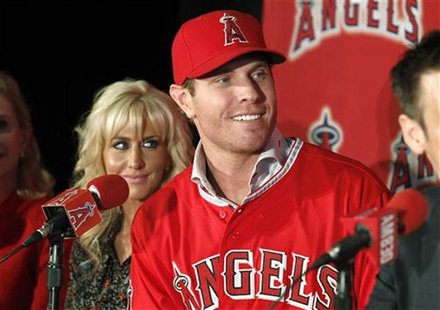
While others have certainly made moves that could prove momentous down the road, these three franchises captured much of the attention this offseason. The Angels are the proud new owners of center fielder Josh Hamilton, which is the equivalent of buying a Lamborghini to wedge in between your Bentley and Maybach. Sure, it's probably too expensive and not the most practical investment. Hamilton's addiction struggles could sink him at any moment. But when everything is humming just right, it's a rare experience. After all, how many players have found themselves compared to Mickey Mantle? In Hamilton and Mike Trout, the Angels now have two.
There was Twitter speculation that Trout could score 200 runs in front of a lineup including Hamilton, Albert Pujols and Mark Trumbo. That might sound absurd, but consider that he reached 129 runs in just 139 games during Pujols' worst year ever. Maybe 200 is a bit of a stretch, but 180 certainly seems reasonable.
 Lost amid all that late-offseason excitement was the fact that Los Angeles also shored up its pitching corps. That unit held the team back in 2012, but Ryan Madson, Joe Blanton and Tommy Hanson should help on the margins and provide significant upside for an 89-win team that only needs a small boost to leapfrog its way to a division title.
With the Angels holding all aces, the Mets can take some consolation in the fact that they are finally playing with a full hand again. General Manager Sandy Alderson warned that the rebuilding process would be lengthy, and on that point at least, the underachieving Mets have come through. But give them points for sticking to a plan, especially amid the typical New York uproar. They chose one fan favorite (David Wright) over another (R.A. Dickey), an accomplishment considering their still-stretched finances. And for all of the botched optics around Dickey's trade, they played the 38-year-old knuckleballer into an impressive haul. By adding Travis D'Arnaud and Noah Snydergaard, the Mets now have long-term solutions at catcher, shortstop (22-year-old Ruben Tejada) and for three-fifths of its pitching rotation. Add in Wright, and it's almost enough to dull the pain of being perhaps the first franchise to let a batting champ (Jose Reyes) and a Cy Young winner (Dickey) walk in two consecutive years. It could be ugly for a season or two, but Alderson and the Mets are hoarding their chips and settling in for the long haul.
 Which brings us to the Red Sox, the third big-market player and perhaps the most baffling. The team's main haul so far is catcher/first baseman Mike Napoli and outfielders Jonny Gomes and Shane Victorino, which sounds like the core of a .500 team in 2009 and isn't much more promising in this day and age. Napoli is wholly unpredictable, following a standout 2011 with a .227/.343/.469 line in 2012. He also creates a glut behind the plate. The Sox already have backstops Jarrod Saltalamacchia and Ryan Lavarnway, and this offseason also added human placeholder David Ross. At first base, meanwhile, Napoli's total zone defense was a bruising five runs below average.
Similarly, it's hard to see where the impatient, low-power Gomes fits in beyond a stopgap role. He did hit .480 with runners in scoring position and two outs, but for that to pay dividends, there's a lot of work that needs to be done with the rest of the lineup.
Victorino could be the worst signing of them all. For three years and $39 million, the Sox get an aging center fielder coming off his worst year for a price on par with with what more promising players like B.J. Upton or Angel Pagain are receiving. Not to mention that Boston already has a centerfielder in 29-year-old Jacoby Ellsbury. For those scoring at home, that's four catchers, two center fielders and approximately zero progress toward replacing the talent lost following this past year's epic collapse.
That's the difficulty with getting stuck in the middle, though. The Angels see an opportunity and are throwing everything at it in hopes of a grand payoff. The Mets are folding in 2013 and in search of a more promising future. And the Sox can either bide their time and bleed chips or jump the gun and do something crazy. Either way, you hope they have a plan.
That's how it appears now, at least. Fortunes can turn on a small decision, and the games are far from started. The Red Sox could stage a full reveal that puts all the seemingly mismatched pieces each perfectly in their place. The Mets could grow up quick, reeling off win after precocious win and wash away this year's sour taste. Los Angeles could trip and then topple under the pressure, becoming just the latest superteam to disappoint. The offseason is a crucial time, but ultimately just one hand in a long and unpredictable game.
Adam Cancryn is an editor and co-founder of Began in '96.


