Content

Showing posts with label College Football. Show all posts

Redemption and rugby: This (could be) the Maurice Clarett story

March 28, 2013 2 comments

By Adam Cancryn

Former All-American-turned-NFL washout Maurice Clarett is the unlikely ambassador who could vault U.S. rugby sevens into the national spotlight.

Maurice Clarett is training for a comeback.

Yes, that's a story we've heard many times before. There was 2004, when the Broncos took a third-round flyer on the Ohio State running back, even though he hadn't played in a year.

Then came 2005, when those same Broncos released him and Clarett went looking for a new team. He never got the chance; an armed robbery conviction landed him in jail for four years.

Finally free in 2010, Clarett caught on with the United Football League's Omaha Nighthawks. It was comeback time again for the one-time Parade All-American. Yet within 12 months, Clarett was back on the street.

Three strikes, the saying goes, and you're out. So you'd be forgiven for wanting to skip to the seemingly inevitable end of this latest attempt, where an unemployed Clarett fades back into anonymity. And we might indeed get there. But there's a reason that this time might be different, a reason that might be worth just the slightest shred of optimism.
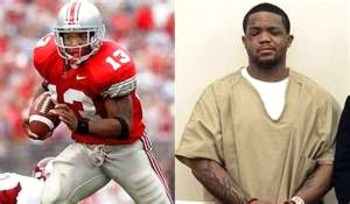
The reason is that Clarett is not training for a return to football. No, the now 29-year-old who rushed for 1,237 yards as a college freshman and scored the national championship-winning touchdown has instead set his sights on rugby. The U.S. men's rugby sevens team, to be exact.

In most cases, that'd be the punchline to a sad career. The washed-up athlete, grasping for the last remaining bits of glory by slumming it in any sport that'll take him. Not with Clarett, though. Not when his comeback could hold the key to the future of U.S. rugby. Not when success here might mean a second chance for all the other athletes who were just a bit too small, or too injured, or too immature their first time around.

If you haven't heard of rugby sevens, you will soon. It's the newest Olympic sport, a stripped-down version of traditional 15-man rugby union that eliminates the brutal scrums and no-necked enforcers most commonly associated with the sport. In their place are the equivalent of seven running backs per side who scramble up and down a spacious field in what, to the uninitiated, can look like a well-coordinated mix of football, soccer and Calvinball.

It's a game that emphasizes speed, power and broken-field running, so it's no mystery that Clarett would want to give it a shot. The U.S. is stocking up for Rio in 2016, and what it lacks in homegrown rugby talent it's looking to poach from the nation's football fields. Already the team boasts ex-Dolphins safety Miles Craigwell and ultra-fast former D-II track and football star Carlin Isles, the latter of whom's highlight reels have introduced many an American to rugby sevens in the space of the one year he's played the sport.


But it is Clarett who could serve as the inflection point. He is the high-profile figure the football-to-rugby migration needs, the one who's second act could be as not just a rugby star but an ambassador for the game. His success could convince others toiling in professional football's lower leagues, or staring down the ends of their college careers, to pick up the odd-shaped ball and give it a go.

There would certainly be no shortage of candidates. For all the players drafted into the NFL each year, there are multiple times that many who were too small (like the 5'8," 160-pound Isles), or buried in the depth chart (like Craigwell) or just not ready for the spotlight, like Clarett. Bringing just a fraction of those over to rugby sevens would flood the U.S.'s pipeline. Americans always boast that the U.S. could win gold in any Olympic sport if it put even half the resources into it that it does football or basketball. Rugby sevens represents the chance to prove that, and it starts with Clarett.

Which is why this time, the comeback story might be different. There's still a long way to go; rugby sevens requires the constant running that football players aren't conditioned for. And Clarett will never be his otherworldly 20-year-old self again. But his training thus far has drawn raves.

"He's ridiculous. That's all I can say," Tiger Rugby Olympic Development Program Director Paul Holmes told Rugby Magazine last week. "His footwork is phenomenal. He's nowhere near conditioned for rugby, but that will come. ... The stuff he's doing in the gym right now, he's just ridiculous."

This is Clarett's fourth chance, a rare shot at rewriting an ending that by now we all know by heart. The hope is that he realizes that, and that he realizes his fortunes are now tied to the fortunes of all those just like him. The hope is that he shows up to training each day, pushed by his football failures and pulled forward by the allure of what could await him and U.S. rugby sevens.

Adam Cancryn is an editor and co-founder of Began in '96.
Read more »

Seeberg, Sullivan, Andreu, Lollar and Baker: These are the little people

January 23, 2013 2 comments

By Adam Cancryn

The people harmed in the making of heroes.

Lizzy Seeberg. Declan Sullivan. Betsy Andreu. Richard Lollar. Jacinth Baker.

Remember those names. Those names belong to the little people. They belong to the ones who got in the way. The ones who threatened a Very Important Person, and in the process were defamed, tortured and even killed.

***

Lizzy Seeberg. She was 19 years old in August 2010, a freshman at St. Mary's College taking her first steps toward becoming a nurse. By September, she was dead.

What happened in between is well-chronicled and yet still shrouded in mystery.We know that Seeberg was allegedly assaulted in a dorm room one night by a Notre Dame football player, an attack cut short only by a knock on the door. She later told her friends about the episode, and then reported the assault to Notre Dame police, submitted DNA to the local hospital and sought counseling.

Then came the threats. "Don't do anything you would regret," a text from one of the player's friends read. "Messing with notre dame football is a bad idea."

She became so fearful of the backlash that she went out of her way to show support for the Fighting Irish, donning Notre Dame gear and attending the football team's home opener. That night, Seeberg would watch as her attacker take the field to the approval of thousands of fans around her. The next week, she was found dead, stomach pumped full of anti-depressants.

That's what we know. It's been more than two years now, and there have been no arrests. There has been no more information. Notre Dame and St. Mary's administrators have stonewalled reporters. The accused attacker, whose yearbook photo Seeberg showed to police, remains free and anonymous. In January, he suited up for the BCS National Championship Game. He continues to live his life, uninterrupted. You don't mess with Notre Dame football.

***

Declan Sullivan. A junior at that same so-called higher institution and the videographer for the Fighting Irish. He rode a scissor lift 50 feet in the air one day in October 2010, ordered up there by head coach Brian Kelly. Standing five stories above the practice field, winds whipped past him at more than 60 miles per hour. In between taping the team's workout, he tapped out a quick tweet: "Gusts of wind up to 60 mph. Well today will be fun at work. I guess I've lived long enough."

An hour later: "This is terrifying."

And then he was falling. After they finished loading Sullivan's battered body into an ambulance, practice continued for nearly a half-hour more.

An investigation concluded some time after Sullivan's death. It found that Kelly, the newly minted and high-profile head coach who put a 20-year-old 50 feet in the air amid high winds to tape a routine practice, had acted with the character and values in "accord with the highest standards of Notre Dame."

In January, Kelly led the Notre Dame football team and Lizzy Seeberg's alleged attacker onto the field for the BCS National Championship Game. As for Declan Sullivan, I guess he'd lived long enough.

***

Betsy Andreu. She's the wife of cyclist Freddie Andreu, and the ex-friend of Lance Armstrong. She is also the one who witnessed Armstrong confess to doping during a hospital visit in 1996, and who found herself alone when she refused to lie about it. Andreu endured a public smear campaign and private threats. She was "crazy," a "psycho" and a "bitch," according to Armstrong and his operatives. A message left on Andreu's phone hoped someone would break "a baseball bat over [her] head." For years, she was the villain. She was the one trying to tear down Lance, the Great American Hero. The public crushed her in its scramble to sit at Armstrong's feet.

It's been 17 years since Andreu sat in that hospital room. She is finally vindicated, yet the scars remain. Given a chance to make amends this past week as part of his public rehabilitation, Armstrong admitted to calling her crazy and a bitch, but: "I never called you fat."

A smug smile crept across his lips.

***

Richard Lollar and Jacinth Baker. Shortly after the St. Louis Rams won Super Bowl XXXIV, they went to a party at an Atlanta nightclub and never came home.

The man who knows why they were stabbed to death, and by whom, now prepares for his second shot at a title since that night in January 2000. Ray Lewis is an NFL icon and a sure Hall of Famer now, but back on that night was just the witness to a double murder. He then jumped into his limo, told the other passengers to "keep their mouts shut," and fled the scene.

Lewis would later negotiate a deal to drop the murder charges against him in exchange for testimony against two of his friends. In court, he refused to link those friends to the killings, and all were acquitted. Lewis paid the NFL a $250,000 fine and began a reinvention that turned him into the favored son of both Baltimore and the NFL's marketing team.

Lollar and Baker's murders remain unsolved, their families left with only grief and unanswered questions. As Lewis heads toward retirement and a cushy job at ESPN, Lollar's aunt told USA Today that she headed for the funeral home, "because that's where my nephew retired."

***

Lizzy Seeberg. Declan Sullivan. Betsy Andreu. Richard Lollar. Jacinth Baker.

Remember those names. Remember them when Notre Dame athletic director Jack Swarbrick tears up and promises justice over star linebacker Manti Te'o's fake girlfriend, yet issues no comment after no comment on the subjects of Seeberg and Sullivan. Remember them when Brian Kelly trots out onto a field surrounded by sea of cheering fans. Remember them when Lance Armstrong embarks on his image restoration tour, and when the cameras find Ray Lewis in the midst of his pregame histrionics.

These are just five of the millions like them in Steubenville and at Penn State and all around the world that threatened Very Important People, and then got swept aside. They are the victims of institutions that place power over justice, that enable the most heinous acts because to not do so would mean sacrificing money or status. It would mean tearing down heroes and exposing flaws. When there are only little people at stake, those like you or me, it's all just too inconvenient.

Lizzy Seeberg. Declan Sullivan. Betsy Andreu. Richard Lollar. Jacinth Baker.

Remember those names. Remember them because those in power desperately want us to forget. Remember them because it's the only way we can start to make things right.

Adam Cancryn is an editor and co-founder of Began in '96.
Read more »

ND-Alabama: The best boring teams left

December 3, 2012 1 comments
al.com
By Adam Cancryn

Notre Dame and Alabama are the best teams left. Whether they're the most enjoyable to watch is another story.

On a crisp November night in 2011, a group of friends and I packed into a narrow Washington, D.C. bar. We were there to watch Alabama and LSU in a late-season matchup of the nation's top-ranked teams. Most everyone in that bar was there solely for that purpose too, if I recall, which was a bit odd on a Saturday night in Adams Morgan. But that's how big this game was, hyped nonstop for the past week as the most momentous meeting in recent college football history.

I hadn't seen much of either team at that point, but based on the attention surrounding them, I figured it could be a treat. At best, we'd witness some sort of history. At worst, it'd be a few enjoyable hours of football.

I was wrong. What unfolded that night was neither historic (Alabama and LSU would meet again a few weeks later in the title game) nor enjoyable. It was, quite simply, the dullest sporting experience I can remember. The teams traded three-yard runs and wobbly passes for a few quarters, crashing into each other again and again and yet rarely making it past the opposing 40-yard line. When the dust cleared, LSU had "won," 9-6, in overtime. After hanging in for the entire game in hopes that something great might happen, we fled the bar before football could inflict any more damage on our psyche.

Come the morning, though, I wondered whether I'd been watching the right channel. LSU-Alabama was hailed as an instant classic, the epitome of football at its old-school, smash-mouth best. By 1930s leather helmet standards, maybe. Here in the modern world, the term for something that produces this ugly of a box score* is "painful." The defenses were impressive, sure. But they were rarely tested, unless you count the challenge of staying awake while LSU debated which quarterback would attempt its next half-hearted throw.

* It's worth combing through the box score just to marvel at the absolute lack of offense that went on here. LSU, the best team in the country, used two quarterbacks who combined for 99 yards passing! Their starting running back averaged 1.8 yards per carry! And this was the team that won!

Needless to say, that game stuck with me in a way I imagine is most closely comparable to a bad acid trip. And this past Saturday, when quarterback A.J. McCarron flung — Tebow-like — a 45-yard touchdown pass to put Alabama up late, I immediately thought back to that night. By the time Georgia became the latest SEC team to fail at the maths portion of the game and turn three shots at the end zone into one orgy of ineptitude, that November night in 2011 was front and center in my mind. It's unavoidable now. We're in for what will surely be the most hyped snoozer of a title game possible.

That doesn't mean Alabama and Notre Dame don't deserve to be in this spot. They took care of business while others faltered, and while there are always cases to be made for other teams*, these two are abundantly reasonable choices. Fans of both schools will certainly enjoy the show.

* Florida has the best case by far, having lost only to Georgia while beating seven teams with winning records, including Texas A&M. Georgia beat just three with winning records (Florida, Georgia Southern & Vanderbilt), while Alabama lost to Texas A&M and played an easier overall schedule.

But for the rest of us: Oof. In one corner, you've got Alabama, that paragon of SEC stubbornness. Their mentality is so traditional that for much of the game against Georgia they all but abandoned the forward pass. Before McCarron's fourth-quarter fling, he'd completed four passes for 22 yards in entire the second half. The Crimson Tide's game plan is simple; they're going to run right, run left, and run up the middle and dare you to stop it. When the defense crowds the line, McCarron's leash is loosened (but just a little) to take advantage of single coverage. It's simple and effective, and brutal to watch.

I'll take three yards and a cloud of dust over Notre Dame, though. The Fighting Irish have one of the worst offenses of any ranked team this year, and are historically bad compared with previous national champions. By Sports Reference LLC's Simple Rating System, Notre Dame's offense is 1.55 points above average, good for 57th in the nation (Alabama ranked 43rd at 3.89 points). By comparison, potential title contenders Oregon, Georgia and Florida finished third, 16th and 49th, respectively. You have to go back to the 2002 Ohio State Buckeyes, quarterbacked by Craig Krenzel, to find a team anywhere close to approaching Notre Dame's lack of production. Their 12-0 record is a tribute to the defense, which held onto numerous slim leads while the offense tried to get out of its own way. That squad will have to turn in its best performance of the year against Alabama, which boasts a defense of its own that could hold the Fighting Irish to single digits.

Everyone enjoys a defensive struggle once in a while, and the national title game should certainly deliver on that. Whether that struggle is exciting is another story. There's a difference in football between competitive and enjoyable, and Alabama-Notre Dame are prime contenders to demonstrate just how wide that gap is. Keep that in mind as the chatter surrounding this game hits full volume over the next five weeks. Adjust your expectations accordingly. And if you insist on watching, do it in a group. Friends don't let friends watch a snoozer like this alone.

Adam Cancryn is an editor and co-founder of Began in '96.
Read more »

The start

July 25, 2012 2 comments

By Adam Cancryn

The NCAA penalties applied to Penn State must be the beginning of something larger.

This is a start.

On Monday, the NCAA slapped Penn State with the stiffest set of penalties for a D1 school in a quarter century. Each one of the sanctions struck at the core of the monolith of unchecked power known as the university football program, and together, they served to cripple that program. Penn State football's recent past, obliterated. It's foreseeable future, gone. Right now, there is no hope left for football in Happy Valley.

And that's as it should be. How do you punish a program filled with men who stood knowingly yet idly by while that same sense of hope was snuffed out in child after child over the course of 13 years, and maybe more? What is adequate justice? Can that even be achieved? It's a question that might never be satisfactorily answered.

The NCAA tried, though, and in doing so performed as respectably as could be expected. Its penalties were harsh, but well thought-out. They were designed not for maximum shock value, but to hit those responsible with all its might.

Vacating wins is normally a hollow exercise, one ignored by the institution at fault and its fans. But here, that simple sanction has a brutal effect. It succeeds in wiping out the remnants of Joe Paterno's legacy, eliminating his much-revered title as winningest coach in college football. Stripped of 13 years of wins, he now sits a forgotten 12th on the all-time list. Gone also are his bowl wins and milestones over that period that served as Paterno's canonization. The last chapter of his football resume sits empty now, a stark mirror of his morals.

In an extra twist of the knife, the last quarterback to lead Paterno's Penn State to an official victory is Mike McQueary, the man whose initial report about Jerry Sandusky went unheeded.

The scholarship losses and bowl ban strikes at the future, erasing Penn State from contention until at least 2020, by some estimates. It's the "new death penalty," Yahoo!'s Charles Robinson said on Twitter: Severe enough to gut the program, yet not permanent so as to make a martyr out of it. At the same time, all current players are given a potential escape route from the cloud that covers Penn State. They can transfer elsewhere with no eligibility penalties. It's not perfect, but it's the best of a bad situation.

So this is a start. It's a chance for the NCAAto remake itself as the fair-minded regulator of college athletics, rather than the corrupt handmaiden to big-time sports, a role it's played far too well in years past. The NCAA has failed at nearly every attempt to police and punish its member universities, and a misstep with Penn State would have been both easy and ruinous. Indeed, several writers seemed to have their condemnations of the organization ready to ship no matter the final outcome.

Yet the NCAA demonstrated the kind of measured response it has often lacked. Its consent decree from Penn State was perhaps the most crucial part, given the questions around its use of unilateral power. And while cleaning up college sports is like taking a mop to a flash flood, there is a glimmer of hope that this might mark a turning point. The NCAA now has the opportunity to start doing its job in full, if it wants.

This is a start. Toward a culture change at Penn State, toward reform throughout college sports. But it's just that: A start, and nothing more. The university, the town of State College, the Pennsylvania authorities and the collegiate athletic system must take it from here. The entire Penn State Board of Trustees must go. Criminal charges must be filed against those — all of those — who broke the law to cover up Sandusky's crimes. The culture of hero worship and hush-hush attitudes in State College and every other university community must be destroyed. And within those schools, the sports-above-all mentality must change.

Right now, all of that is more a wish list than an imminent reality. One only needs to look to the NCAA's massive TV contracts, or peek at the vilest reactions to Penn State's sanctions, to grasp how ingrained the current system has become. But until that changes, we won't be done. These penalties and hard words won't be enough. Aided by an age of unprecedented power, profit-taking and muddled priorities, countless children saw their shot at a normal life end. Out of that end must come the start of a new, better era.

Adam Cancryn is an editor and co-founder of Began in '96.
Read more »

In a post-Sandusky world, a new challenge

July 9, 2012 2 comments

By Michael Bennett

The Jerry Sandusky story has come to a close, but our understanding of the roots of child abuse is still in its infancy.

For Jerry Sandusky, justice has been served. The 68-year-old went from State College saint to American monster, and following a speedy yet troublesome trial, Joe Paterno’s former right hand man now spends his days behind bars. Cheers followed the verdict. Millions exhaled. We’re safe from old man Jerry.
 
But amid the relief, have we reached any sort of resolution? Have we stopped to realize that Sandusky has yet to even admit to these horrible crimes? We might want to believe that courthouse verdicts fix the problem, but in many ways, one man’s public punishment only masks the broader problems that we must continue fighting to address. 
 
I’ll admit it: I’m happy to hear the media reports that Sandusky hates his prison food. Like many others, I found it funny that his fellow convicts reportedly taunted him with Pink Floyd lyrics. And yet, what has justice done if this so-called “monster” can’t even recognize his actions? If his fervent denials reveal anything, it’s that he, like many others out there, is a very sick man. So while we might sleep a little better knowing that Sandusky is being punished, we have made little progress in the realm of prevention. 

It’s in that vein that we need to continue to investigate this nightmare for more lessons we might learn from it. We can’t treat Sandusky’s crimes as an isolated incident, as just one case of one man abusing his power as a local legend. The fact is, there are many more people out there committing the same horrible crimes of which Sandusky was convicted. What are we doing to stop those, and how can we better prevent them from happening in the first place? Justice after the fact is a weak substitute for ensuring that this kind of serial abuse isn’t allowed to start. 
 
Emphasizing prevention over persecution will require a shift in our thinking, one that takes into account the situation not just of the potential victims but also the potential criminals. The urge to commit pedophilic acts should never be accepted or tolerated, but it must be better understood. It’s easy just to label people like Sandusky as monsters, as something subhuman. But that does nothing to help us comprehend, and hopefully remedy, the psychological issues or other problems at the root of these crimes. We’ve learned so little about what differs pedophiles from the rest of the general population during an era in which we’ve learned so much about nearly everything else. To fail to change that merely because the subject is uncomfortable would be pitiful.

The first step is admitting that this is not a one-time thing, and the high-profile Sandusky case has given all of us the opportunity to do that. There are surely other men (and women) out there that cover their sickness with sainthood. We need to make the decision now that we will no longer be blinded by the façade of goodness. We need to commit to investigating any suspicious activity regardless of a person’s public standing. 

And we need to make sure that people like Sandusky can ask for help, before they succumb to their temptations. Before they destroy the lives of innocent children and submerge themselves in a hidden web of criminal manipulation. Only when we’ve done that can we say that we’ve made significant strides toward preventing child molestation. The spotlight has dimmed on the Sandusky trial, but the road to prevention has just begun.

Michael Bennett is a contributor to Began in '96.
Read more »

Leaving the game

June 5, 2012 0 comments

By Jason Bacaj

Reflections on loving, and leaving, the game of football.

As I sprinted down the sideline toward the south end zone, I found myself all alone.

I’d already smoked the linebacker trying to cover my wheel route, and as I reached the 15, the quarterback let it go. The pass was behind me, but I managed to twist around and grab it right as I hit the three-yard line. A step later, my right cleat caught the turf and jarred me to the ground. The back of my head hit first, knocking me out.

I came to seconds later, in time to see the referee signaling incomplete. I got up, shook it off and peered toward the sideline for the next play. But everything was blurry, and I couldn’t make out what the coaches were doing or saying. My contact lenses must have gotten knocked out, I thought. I trotted over to the bench, feeling for them on my face. And that’s where my memory ends.

The game film showed me getting the formation from a coach, lining up and firing out into the play, after which I slowly walked to the middle of the field and turned around. We all laughed about it in the film room later that week.

I finished the game, and apparently even made a great downfield block that took out two defenders and played a major role in me grading out higher than any other tight end that game. But after that wheel route, I still don’t remember anything that happened.

This was my sophomore year at Washington and Lee University. It was the fall of 2007, before concussions and their dangers took center stage in the football world. It wasn’t my first concussion and it wasn’t my last, and at the time it was still just a funny injury. But concussions had become a serious issue by my senior year, and after suffering another, more serious one during an intra-squad scrimmage, my football career was effectively over.

Looking back now, stories like those of Junior Seau, David Duerson and Derek Boogard scare me. I think about my time on the field, and I wonder what might happen to me. Sure, the three of them were professional athletes who spent substantial careers hurling themselves against men much larger than my Division III opponents. But does that mean I’m safe? At what point, and at what level, does Chronic Traumatic Encephalopathy set in? No one knows.

No one knows much about anything until after the athletes die, at which point it’s hard to glean anything definitive about why they chose to kill themselves. The popular hypothesis is that the players weren’t prepared for life after football. It’s a hard thing to adjust to, and something I faced when, mercifully, I realized there was no way I would make it to the NFL as a 6’1”, 210-pound tight end.

Staring at the end of my football career in 2008, I decided to call one of my old high school football coaches, Jeff. Maybe I could learn something of my future from his past.

After talking to him, I wrote about the difficulties of adjusting to life after football, and the man who was able to handle those challenges well. A few years later, I hope I have, too.

***

When I called around for this story, I got a few answering machines and had a few frustrating days where I did next to nothing. More than a few of those, actually. But I suppose that’s what you get when you're trying to learn something about your future from someone else's past. Those few moments of self-reflection in between phone calls were fitting, even if I didn't understand why at the time. Finally, though, that distinctive voice reached my ear, saying, “Oh yeah, I got your message last night, what's this you’re doing?” Things were “booming, just booming,” back in Morgantown. Construction was going well, the town was growing, his son was having fun at football practice.

It was my old coach Jeff. I’d called him to see how he had dealt with leaving football. My own career is ending soon, and I wanted to see what it was like for him to leave the game he loved, the game he grew up with. The game he, like so many other people, watched with his older brothers, cheering on the Steelers and Chiefs during the first half and then going out and playing the second half in the backyard.

Jeff played football with his brothers until seventh grade, when he took his game to the gridiron. The season lasted just two games, but it must have been a great two games, because he never returned to the backyard.

Jeff went on to play high school football, along with a couple other sports, at a small single-A school in southwestern Pennsylvania. There were so few single-A schools that they had to play up a division, and Jeff got to play organized ball with his younger brother for three years.

"Just being able to play with him," he said. "That was great."

Funny story about that: When he was a junior, Jeff started at quarterback. When he was a senior, the team didn’t have a tailback, so Jeff moved there and his brother played quarterback. He was a Parade All-America at linebacker that year and got recruited by Division-1 schools like Stanford, Notre Dame and Penn State.

But Jeff’s recruiting experience wasn’t really about the football. He was a Mennonite farm boy from Pennsylvania, and this was the first time he had the chance to travel around the United States. He visited Stanford to see the sun set in the Pacific. He saw Notre Dame in the Midwest, mainly because they were playing UCLA, his favorite basketball team at the time. When it came time to choose, Jeff ended up staying close to family, close to those who first introduced him to the game. He went to play for Joe Paterno and the Penn State Nittany Lions, the same place that his two older brothers went.

Football became a year-round thing for the first time in his life. In high school, Jeff said he’d prepare maybe a few months before the season began. But in college, training began a month after the last season ended. He ended up transferring to West Virginia University, a little closer to his southwestern Pennsylvania roots, where he got the opportunity to play quarterback.

Jeff played all right in those two seasons, leading the Mountaineers to victory over the ninth-ranked Oklahoma Sooners in his first game as the starter. His biggest challenge was keeping up on schoolwork amid all the expectations and commitment.

"You really had to make sure you used your time extremely efficiently," Jeff said. It's tough on a young man coming from a high school, where you played with your little brother and your friends, to a college where "you’re a medium fish in a tank full of big fish." Even when you made the team, when you solidified your position, there was always someone breathing down your neck.

"Playin' in front of 60,000, 70,000, 80,000 people and being judged, with your self-worth attached to how well you played," Jeff said. "As a young man … you had to figure out ways to convince yourself that that wasn't the case."

It helped that everyone on the team was supportive. Like a big family, they all looked out for one other. Everybody got along with everybody else, and eventually, they were like brothers.

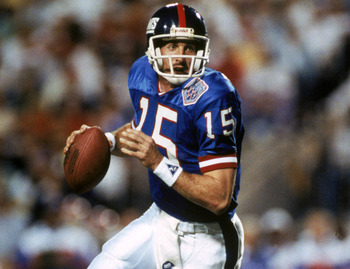
Jeff played well enough at WVU to get invited to a combine. There were two at the time. He was paraded in front of everybody in his gray NFL shorts, shuffled through like a piece of meat. It was a process different from anything he'd ever experienced, but by the end, he’d done all right. Experts projected that the first quarterback selected would either be him or Boomer Esiason. Jeff ended up getting taken after Esiason, by the Giants, with the second pick of the third round.

"It's real frustrating," he said of the lead-up to the draft. "You just want to get drafted and move on to the next step in the process."

Jeff realized pretty quickly that the NFL was a lot different from college. There's no security in the pros, you weren't just competing for a position. You were competing for a job, a livelihood. There are bigger, faster, younger players coming into the league each year.

For Jeff, the toughest part was the mental aspect. There wasn't any schoolwork to distract you from the game; you were either in season, training to get in shape for the season, or in mini-camps and training camp preparing for the season as a team. And it was when that year-round season mentality began to take a physical toll that Jeff knew it was time to step back. His body couldn’t recover from the last season before the next one began. Then, his mental desire began to slip. And when you aren't prepared for the NFL, he said, you cheat everybody involved. The guy who grew up playing with his brothers and looking after his college teammates wasn't going to cheat his extended NFL family. So Jeff stepped away.

Jeff's last name is Hostetler. It's okay if you don't recognize it. Few, if any, of my friends in college do. They only know him by what I tell them, from the stories about my old coach. That old guy, who still has an NFL build, who challenged 17-year-olds and 18-year-olds to races and throwing contests and won all of them. The guy who called me slow, who threw footballs at my helmet while I tried, fruitlessly, to pick it up before practice. The guy huddling us up before the half to draw up a two-minute drill in the palm of his hand (we scored).

They don't know about how he was a Parade All-America, about his spot on WVU's all-time roster, his place in NFL history, or how he led the New York Giants to a Super Bowl victory in 1990.

And that's what a football career should be: The past, a fun thing you were pretty good at back in the day, not your defining characteristic. It's just a game. Sure, it can be transcendent, but that's for people outside the game who don't know the camaraderie of the locker room. Because that's what you miss. Not the flashbulbs and the rings. They're great, but you remember that time you caught a snapping turtle before practice and almost put it in one of your teammate's helmet, or put an "I’m gay and proud" sign on Howie Long's license plate and watched him drive around Los Angeles without noticing.

Sometimes I wonder about how I would answer the question, Who are you? Without fail, one of the first things that comes to mind, after my name, is that I play football. I had hoped to talk with Jeff about how he dealt with losing that part of his life, that part that defined him for so long, too. But we got so caught up talking about different pranks and old stories that I didn't even have time to ask him that question.

Jeff's a busy man now, running a real estate development company called Three Arrows Development Inc. The name comes from a passage in the Book of Psalms about kids being a blessing like arrows to a warrior. Jeff has three sons, hence the name Three Arrows.

When I was interviewing him, he was at the airport going somewhere, on business or vacation, I didn't ask. But he had to go before he could answer me. Now, thinking back on the story he told me about his life and his experience with football, I don't think he had to. He left football because his body couldn't take the punishment any more. He left, but football didn't leave him, because he never let football define who he was. Playing was always a just a game. What defined him was something deeper. It was the family. It was a brotherhood that was with him from his first day in the backyard until the last time he shut his locker.

And I think if he had answered me, he probably would have just smiled and given me a stock line about how it's just a game. You can't really explain what it is, what it's like to leave it. It's personal, and the experiences and memories are to be treasured but not displayed. Much like Jeff's ubiquitous moustache, it's a part of you. People can see it, and you can't hide it. So you just smile, and tell them it's just a game.

Jason Bacaj is Began in '96's Out West contributor.
Read more »

The Winning Gene

May 4, 2012 1 comments
                                                                                                                                                                      Photo Credit: Jake Putman

By Joe Schackman


If being a "winner" really meant something to NFL teams then Kellen Moore would not have gone undrafted


Tim Tebow is a winner in the NFL. His 8-5 record as a starter, including a wildcard defeat of the Steelers, cannot be disputed (as much as I try). He won games; it's that simple. But the why is much more difficult. Any casual observer could see the Tebow did not fit the typical quarterback mold. He struggled to complete passes and his most effective plays were made with his feet. So how come all the success?

Tebow, who has compiled victories at every level of competitive football, was simply deemed a “winner.” The pundits and fans could not explain his victories with traditional stats and strategy. So they assumed that Tebow was just able to just “find a way to win” thanks to a talent that doesn’t show up in the box score. But the question now is, if the ability to “win” is so crucial to success, why did the winningest quarterback in college football history go undrafted last weekend?

Kellen Moore is not your classic quarterback prospect. First of all he did not play for a storied college football program. He is not an exceptionally gifted athlete nor does he have the prototypical size and strength that scouts covet. Rather he is an extremely accurate, football-smart, quarterback who compiled one of the most impressive starting quarterback resumes ever in NCAA football.

Over his four years at Boise State, Moore, the son of a football coach, started 53 games. His team lost only three times. Two of them in the most crushing way possible. With Boise State on the brink of a potential National Championship bid in 2010 and BCS bowl in 2011, Boise’s kickers missed two chip shot field goals that ultimately led to their downfall. 

Apparently only Tim Tebow can will field goals through the upright because when the 2012 draft rolled around this weekend, no team was willing to take a chance on the greatest winner division-1 football has ever seen. But despite all his success in college no team was willing to risk even a seventh rounder on the hyper-accurate quarterback. Instead opting for guys like Ryan Lindley of San Diego State, B.J. Coleman of Chattanooga and Chandler Harnish of Northern Illinois. 

So why no love from NFL teams for this proven winner?

It comes down to the fact that the concept of a “winner” is flawed. Often the real explanation is much less exciting and interesting and victories come as a result of forces recognizable on this earth. Good scheming, timely play making and a lot of luck.

Photo from NY Daily News
Mark Sanchez stockpiled victories early in his career, despite showing little success on the stat sheet. As he lead his team to back-to-back AFC Championship game appearances, people were scratching their heads as to how a team could buck the trend and sustain success with average quarterback play. They ignored the dominating defense and strong rushing attack and gave credit to Sanchez’s winning abilities. It was the same way people ignored the emergence of the Broncos defense behind rookie linebacker Von Miller and their easy stretch of games, along with brilliant scheming from head coach John Fox.

But with the Jet’s struggles this year Sanchez quickly lost his status. As the Jets dropped games people began to focus in more on his stats and fans criticized him more for his poor performance on the field.

NFL front offices have always seen through this. They knew Kellen Moore’s victories in college did not signal some hidden gene and were not willing to risk a precious pick just because he is a “winner. The same way the Broncos ignored quarterback Jay Cutler's losing record in college before making him the 11th overall pick in the 2006 NFL draft (Cutler has since developed into one of the better signal callers in the league). 

Moore still has a chance to develop into a pro-quality QB. He was signed by the Lions to be their third string quarterback and hopefully is looking at a long career in the NFL. His competitive nature, accurate arm and a bit of luck will be the factors if he does succeed in the league. Not because he won some games in college.


Joe Schackman is an editor and Co-Founder of Began in '96
Read more »

The NCAA's unfair play

February 9, 2012 0 comments

By Mary Grace Miller

The NCAA is finally facing legal and media pushback for its absolute, and potentially illegal, control over "student-athletes."

The National Collegiate Athletic Association was established in 1906 on the principle that student-athletes should be protected. But today, the nonprofit, tax-exempt organization does a better job exploiting these student-athletes than protecting them.
Over the last 100-plus years, it has become clear that the NCAA views these “student-athletes” as, in fact, just athletes. Scandal after scandal has hit the newspapers: athletes accepting tattoos or selling their jerseys in exchange for cash -- and even a coach looking the other way. These acts are clearly wrong under the current regulations. But once you get a true understanding of how the NCAA operates, it’s hard not to want to tell every star player to go sell his jersey.
In the past few months, the image of the NCAA as an immoral and, likely unlawful, bully has begun to emerge. New York Times columnist Joe Nocera has played a central role by calling for players to be compensated, comparing the NCAA to a cartel, and even calling out Harvard as a “scaredy cat” for failing to stand up to the NCAA’s “pettiness.”  
Nocera is not the only one to comment. Taylor Branch, a prominent civil rights writer and Pulitzer Prize-winning author, wrote a moving piece in The Atlantic titled “The Shame of College Sports". Branch notes that college players get nothing and have few, if any, rights as NCAA athletes. Even with a full tuition scholarship, they are not compensated anywhere close to the equivalent of the millions of dollars that everyone else makes thanks off of their immense talent. Not even men's basketball and football players have the right to profit, even though that tiny percentage of the total college athlete population brings in a whopping 90% of the NCAA's annual revenue.
That disparity exists because of the regulations students must agree to before stepping foot on any NCAA-sanction court or field, regulations that have created a nonsensical system where student-athletes -- the very people the NCAA was created to protect -- sign away rights that the NCAA argues they never had to begin with.
Why won't the NCAA at least let the kids who make millions of dollars each year for corporate execs and television networks live above the poverty line?
It's hard to wrestle with the idea that college students would truly be paid for their athletic prowess, but a number of proposals have been made in an effort to find a fair balance. If the NCAA is truly an organization charged with protecting student-athletes, shouldn’t it be leading the way? Shouldn’t it be finding a way to provide adequate living allowances rather than requiring kids to sign away their rights to their images and likeness, among other things?
Instead, the NCAA has swung to the other end of the spectrum. It intentionally coined the term “student-athlete” in an effort to eliminate the possibility that a student may try to claim workers' compensation. Under the NCAA’s definition, the student is not a worker, even if every bit of common sense points to big-time football and basketball players being at least part-time employees.
It's also robbed students of the opportunity to ever benefit from their college athletic success. NCAA bylaws require student-athletes to relinquish “all rights in perpetuity to the commercial use of their images, including after they graduate and are no longer subject to NCAA regulations.” That means a college athlete, at no time while in school or after, has the right to profit off of his or her image as a college player.
Student-athletes are finally fighting back against the NCAA's absolute power by taking their grievances to the courts. In In Re Likeness & Licensing Litigation, Ed O’Bannon, a former UCLA basketball star, and other former NCAA star athletes have filed suit against the NCAA and video-game maker EA Sports in an antitrust action. The main claim in the case is that “the NCAA has violated federal antitrust law by unlawfully foreclosing former Division I men’s basketball and football players from receiving any compensation relating to the commercial use of their images and likenesses.”


The court has allowed the claims to proceed despite the NCAA’s motions to dismiss, and will hear the case in May 2013.
Several similar cases against the NCAA have been merged into one, so an action by another player regarding EA Sports has joined the lawsuit. The issue here is the relationship between the NCAA and EA Sports and allegations that that EA Sports agreed “not to offer payment to athletes once they left their college sports careers, in addition to NCAA’s rule prohibiting compensation of current student athletes.” Under antitrust laws, a court may find that to be illegal.

This case is especially important because if the athletes win, it would mean that students, as student-athletes and later as adults, could receive proceeds from their college images. It could also create a bit of a mess for the NCAA. Although this case won’t be heard for a year or so, it seems that the NCAA should be preemptively doing as much for these kids as they can. If they don’t, legislation or a court order may soon require it. 

Something has got to give. The NCAA must start taking steps towards truly protecting the students, or the schools must put pressure on the NCAA to do something. There are a number of possibilities as to how a new, fair and just system would work. Though the concept of paying student-athletes might seem shocking initially, when viewed in a larger context, it becomes the only appropriate step. It's simply compensating human beings for the work they do and the profit they create for so many others. Failing to do so would not only go against the NCAA's so-called principles, but the standards we apply to our society as a whole.

 Mary Grace Miller is a law student and Began in '96 contributor.


Read more »

Flood in the land of Schiano

February 8, 2012 0 comments

By Alex Jankowski

Head Coach Kyle Flood is everything Rutgers was looking for, but he could still struggle to live up to his iconic predecessor.

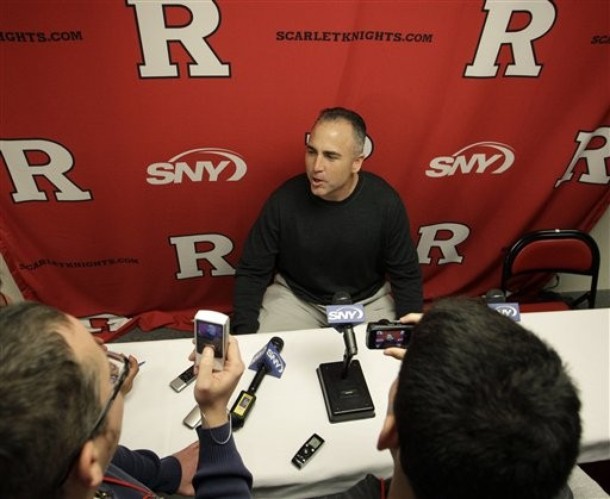
Rutgers University Athletic Director Tim Pernetti last week made Kyle Flood the 29th head coach in school history, removing the interim title that Flood held for the five days after former coach Greg Schiano bolted for the NFL.

The appointment of Flood, who spent seven years under Schiano as an offensive line coach and assistant coach, comes as little surprise. His hire both kept the team's core of assistant coaches intact and shored up ties with the incoming recruiting class.

But was it the right call? Does Flood have what it takes to deliver what Schiano couldn't during his 11 years — a Big East Championship?

In selecting a head coach, Pernetti said he was searching for three things: continuity, core values and connections.

“Somebody who believed in the core values of this program was a big piece of the criteria," he said at the press conference announcing Flood's hiring. "Relationships in the state of Rutgers, the Tri‑state area, in recruiting, [were also] a critical part of the criteria.”

Flood fit each marker on that list. After seven years within the program, the continuity and belief in the system were there. Flood’s ability to connect with recruits and their coaches across the Northeast had also been well documented. And those attributes produced encouraging early returns. After his hiring, nearly all of the verbally committed recruits stuck with Rutgers on Signing Day, forming a class that featured five of The Star-Ledger's top 10 players in New Jersey and 10 of the paper's top 25.

This was a positive that couldn't be overlooked. Programs all over the country had these recruits on speed dial the moment the Schiano news broke, hoping to poach a few from the suddenly vulnerable program. That there was barely any movement, much less a mass exodus, was a testament to not only how well Flood recruits, but how well he gets his message across.

Now the question is whether he has the coaching ability, the expertise to manage in-game situations. Where did those on-field skills fall on Pernetti's list?

For years, Schiano was praised for his ability to motivate players and get recruits to buy into the program. But that didn't exactly translate to success. Schiano's teams often crumbled when it mattered most. 

After the biggest win in the program’s history — a 28-25 win over then-No. 3 Louisville to remain unbeaten in 2006 — the team lost two of its remaining three games to finish out of the running for a Big East Championship and BCS berth. The same could be said about this year. All the Scarlet Knights had to do was beat lowly UConn to clinch at least a share of its first conference title. They fell apart and lost, 40-22. 

Can Flood get Rutgers over that hump? And how will he measure up in the places where Schiano did excel?

A major reason why Rutgers went from 4-8 in 2010 to 9-4 in 2011 was that Schiano took over the defensive play calling. He got the team back to playing the physical and fast style of defensive that first put them on the map. With Schiano in Tampa, a major question mark heading into the season will be how this defense holds up without him.

So Flood inherits a team that, yes, has the most talent on the roster since that '06 season. Yet it also faces a must-win situation. Should West Virginia be granted early exit from the Big East and with Boise State still at least a year away from entry, it will be now or never for the Scarlet Knights.

Flood will have to win this season, and if he doesn’t, he won't have the leeway that Schiano enjoyed for more than a decade. Schiano resurrected the program, and with that came perpetual support from fans and the administration. Flood will not get that luxury.

Hiring Kyle Flood was the quick-fix solution the program needed at a crucial recruiting juncture. Whether he's the long-term solution for Rutgers football remains to be seen. But with heightened expectations, huge shoes to fill and a roster set to make a legitimate run at a BCS bowl game, we will likely find out soon enough.

Alex Jankowski is a freelance journalist currently living in Hartford, Conn. He can be reached on Twitter.


Read more »

Raw Duck

January 17, 2012 0 comments

By Joe Schackman


Darron Thomas may not be the flashiest quarterback prospect. But he has the skills to be a modern quarterback in the NFL. Now will a team take a shot on him?

I was so wrong about Cam Newton that it’s slightly embarrassing.

Honestly, I thought he was going to be a draft bust. Outside of Mike Vick, I had grown so accustomed to seeing the dual-threat quarterback fail time and time again. I was so used seeing to the Vince Young's of the league flame out. Little did I know, by the end of Newton’s first season he would own just about every rookie quarterback record you would want. I was wrong about Cam Newton and now I seriously hope I'm wrong about Darron Thomas.

Despite playing football, Thomas is probably the best point guard on the University of Oregon campus. With weapons like running backs LaMichael James and De'Anthony Thomas, Darron Thomas at times could simply hand/dump the ball off and let those guys go to work.

But that says so little about what Thomas brings to the table. He is the captain of one of the most unique offenses in college football, one built on speed between the whistles and before it. They run plays 32% faster than the average college football team, and Thomas is the one in charge of it all. He’s got to get everyone to the line and and then distribute the ball to his play makers. He has to play fast and think even faster.

After two years running Oregon’s hypercharged system, Thomas has proved he can handle a complicated offense and read defenses. Not to mention, he’s 6’3”, 215 pounds and can run the ball with power and speed, prime attributes for a modern NFL quarterback. Those skills produced 33 touchdowns against just seven interceptions, as well as three scores on the ground. Thomas will need to fix some mechanical and footwork issues to overcome less-than-ideal arm strength, but he excels in all other areas of the quarterback position.

Following an NFL season where the "less talented" quarterbacks have emerged as quality starters, it might be time that we give college success more weight in predicting the future results, particularly with quarterbacks.

With guys like Alex Smith and Tim Tebow leading their respective teams to the playoffs despite gaudy passing numbers, it may mean Darron Thomas, who won two Pac-10/12 titles and a Rose Bowl, deserves a shot at quarterback in the NFL. Not because he has some mythical "winning" gene but because he and others like him work hard and have high football IQs. They are comfortable playing under pressure, being leaders and handling success. Just because they can’t yet throw the perfect back shoulder fade doesn’t mean they can’t command and manage an NFL offense.

Darron Thomas is by no means a top draft choice. He won't go on the first day, and some feel he might not be taken at all. But if some team is willing to take a shot on him and develop him over a few seasons, they may have found themselves a very cheap and low-risk Cam Newton.


Read more »

The .300 Hitter: The manufactured Luck/RGIII question

January 16, 2012 1 comments

By Adam Cancryn

Stanford quarterback Andrew Luck is the consensus No. 1 draft pick, and Robert Griffin III's ascension shouldn't change that.

Now that Andrew Luck and Robert Griffin III are both turning pro, let the games begin.

The second-guessing games.

Luck has been the consensus No. 1 NFL draft pick for two years now. Over that period, he's resurrected the Stanford football program, twice finished second in Heisman voting, inspired a "Suck for Luck" campaign and drawn comparisons to Peyton Manning and Drew Brees.

In November 2010, CBSSports' Rob Rang called Luck the "best quarterback and elite prospect" he's ever scouted, and the overwhelming opinion is that the 6'4" Washington, D.C. native is as sure a thing as you can find coming out of college.

But inevitably, doubts will arise at some point between the end of the NFL season and the draft. Scouts, TV analysts and team front offices will entertain those pesky insecurities that go along with any big investment. Is Luck really that good? Have we hyped him up too much? Is his arm strength/accuracy/mobility what we thought it is?

And what about Robert Griffin III?

Let's do everyone a favor and nip this all in the bud right now. Andrew Luck is the best player in the draft, period. Every snap he's taken over the past two years has been scrutinized and dissected by thousands of experts, and those experts have consistently come to the same conclusion. Luck was the best in 2010, he was the best in 2011 and the few months leading up to the draft aren't going to change that in 2012.

Griffin isn't going to change that either. He's an intriguing athletic specimen, a track star with a strong arm and a knack for making big plays. He's also led a resurrection, turning Baylor from patsy to powerhouse. Considering the success the similarly skilled Cam Newton had in his rookie year with the Panthers, it's tempting to project that same fate onto Griffin.

Yet as exciting and flashy as Griffin might be, he is also erratic and raw; the classic high risk/high reward prospect. Luck, meanwhile, is polished and experienced and unquestionably talented, and therefore also very boring.

The No. 1 pick is made for those boring sure things, though. It's one of the largest, rarest investments a team will make, and for that reason it has to pay off. So when the Indianapolis Colts are put on the clock this April, they must drown out the doubts, go with their gut and make Andrew Luck their next franchise quarterback.


The Week Ahead (all times EST)- Your guide to what to watch-- and what to watch for-- this coming week


College Basketball
Baylor at Kansas- Jan. 16 at 9:30 (ESPN)
Michigan St. at Michigan- Jan. 17 at 7 (ESPN)
Georgetown at Rutgers- Jan. 21 at noon
Virginia Tech at UVa.- Jan. 22 at 6 (ESPNU)
NBA
Lakers at Heat- Jan. 19 at 8 (TNT)
Timberwolves at Clippers- Jan. 20 at 10:30 (ESPN)
NHL
Bruins at Devils- Jan. 19 at 7 (NESN/MSG+)
Penguins at Rangers- Jan. 19 at 7 (FOX PITT/MSG)
Rangers at Bruins- Jan. 21 at 1 (MSG/NESN/NHLNET)
NFL Playoffs
Ravens at Patriots- Jan. 22 at 3 p.m. (CBS)
Giants at 49ers- Jan. 22 at 6:30 p.m. (FOX)
Santana's comeback
Keep an eye on New York Mets' ace John Santana's recovery. The pitcher missed all of the 2011 season, and is eyeing an Opening Day return after throwing on flat ground last week.
Going Pro
Expect more college players to declare for the NFL draft. Baylor's Robert Griffin III, Oregon's LaMichael James and Alabama's Trent Richardson made it official last week, among others.


In the Kitchen- Tracking the major hot stove stories 
  • Highly coveted Cuban defector Yoenis Cespedes has at least six teams chasing after him. The 26-year-old free agent outfielder has drawn interest from the Chicago Cubs, Chicago White Sox, Baltimore Orioles, Cleveland Indians, Detroit Tigers and Miami Marlins. Miami, which has been active throughout the offseason, has said it will be "aggressive right to the point of stupidity" when it comes to Cespedes. 
  • It's looking like the rich might get even richer down in Texas, where the Rangers have had preliminary meetings with Prince Fielder. The former Brewers slugger has also been connected to the Seattle Mariners and Washington Nationals, but it's believed they're not willing to shell out the kind of money that Fielder wants. Though the Rangers are currently negotiating with Japanese import Yu Darvish, should that deal fall through-- or if they have the resources to go after both-- Fielder would top their wish list.
  • The New York Yankees are stockpiling arms again, trading for Mariners hotshot Michael Pineda and signing Hiroki Kuroda. Outside of CC Sabathia, the Yanks haven't had great luck acquiring pitchers-- see Burnett, A.J.-- but Pineda and Kuroda represent different kinds of bets. Pineda is just 22, and under team control for the next five years, giving them plenty of time to get value before having to pay him big money. They had to give up star prospect Jesus Montero to get him, but given the Yankees' offensive firepower and their bandbox of a stadium, great pitchers are more valuable than great hitters. Kuroda, meanwhile, is 36 but was signed for just one year. It's a low risk/high reward deal that won't put New York in a financial hole. 
  • Dmitri Young hasn't played in the MLB since 2008, but he's testing the waters for a comeback. The slimmed-down Young is shopping himself as a cheap gamble that could be a solid bat off the bench or even at first base. 
  • The Boston Red Sox have invited longtime catcher and captain Jason Varitek to training camp, but the loyalty ends there. He'd be a non-roster player, giving him just a slim chance of actually making the team, as Boston already has two catchers. Though Varitek's offensive output has diminished, the Sox were 42-22 last year when he started, as opposed to 48-50 when Jared Saltalamacchia was behind the dish. Varitek will likely either take this invite or retire.
Web Gems- The week's best, worst or strangest Internet sports finds


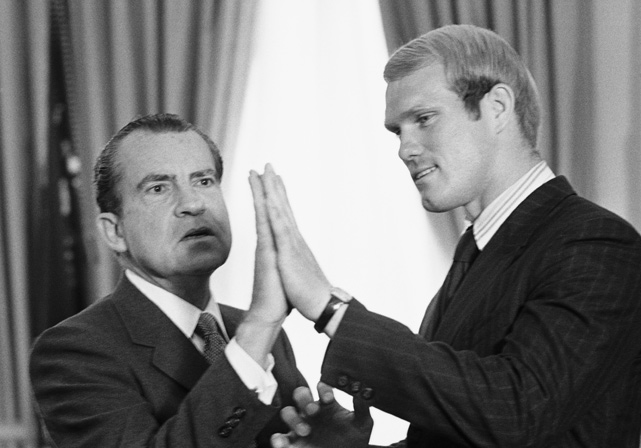
From the SI vault, President Richard Nixon compares hands with then Louisiana Tech quarterback Terry Bradshow in 1970.

Did this man really cut Michael Jordan?- Thomas Lake's magnificent investigation into the story that Michael Jordan was cut in high school, and the divergent paths Jordan and his coach took in the following years.

Coming Up- What's next at Began in '96
  • Later today: The Began in '96 staff makes their sports predictions for 2012
  • Tuesday: Greg Mathews breaks down Prince Fielder's ongoing free agent saga.
  • Wednesday: The story of the upstart UVa. men's basketball team, and the 67-year-old undergrad following them every step of the way, by Adam Cancryn.
  • Thursday: Joe Schackman warns that history tells us not to expect too much from Andrew Luck too soon.
  • Friday: Adam Cancryn wonders how ESPN will fill the news hole left by Tim Tebow's playoff exit.


Read more »

What happens when you look away

November 11, 2011 0 comments

By Ian Roderick

On Penn State, morality, and institutional failure.

Joe Paterno, head coach of the Penn State football team for the past 46 years and the all-time Division I wins leader, with 409 victories, was fired this week. His ouster is the denouement of a spiraling crisis involving allegations of child abuse by one of Paterno’s longtime former assistant coaches, Jerry Sandusky, and the failure of Penn State officials to report Sandusky’s crimes when they were made aware of them nearly a decade ago.

Sandusky is alleged by prosecutors to have molested at least eight young boys over the past fifteen years. The details of this case are difficult to read, and document the failure of several Penn State officials, including Paterno himself, to take action in the face of evidence that Sandusky was preying on young boys. In the spring of 2002, Mike McQueary, then a 28-year-old graduate assistant on Joe Paterno’s coaching staff, witnessed Sandusky, then 59 years old, having anal sex with a young boy in the locker room showers. The next day, McQueary told Paterno about the locker room encounter. Paterno then organized a meeting between McQueary, Athletic Director Tim Curley and university official Gary Schultz. Schultz and Curley promised to look into the matter.

At that point Paterno’s involvement with, and apparent concern for, the allegations ended. It is unclear whether he followed up with Curley or Schultz, and he did not independently contact police officials or take action to bar Sandusky from the football complex. Curley and Schultz, though compelled by Pennsylvania state to report allegations of sexual abuse to authorities within 48 hours, never did.

It is beyond doubt that all four of those men failed that little boy. The question that everyone is asking this week is, Why?

The answer for each individual is surely different and ultimately unknowable in specifics. But are any of us truly surprised that in the opaque, authoritarian culture of college football, members of the establishment would be willing to look away when faced with deviant behavior by one of their own?

In such a culture, when there is a career on the line, as for McQueary, is it not easier to walk out of the locker room than to stay and fight? When an institution and millions of dollars in revenue are threatened, as for Curley and Schultz, is it not best to mislead and cover up? When a legend is threatened to be exposed as myth, as for Paterno, is it not best to pretend to forget, to explain away, to fantasize that everything is as you have always imagined it to be?

The scandal at Penn State is wrenching not only because of the monstrous behavior of the accused molester, but because instead of distracting us from this tragedy, sports played an active role in creating the tragedy. Would such a cover up have happened if tens of millions of dollars weren’t at stake, or if a legendary coach was not concerned with his legacy?

In the spring of 2002, Mike McQueary left a little boy alone in the shower with a monster. By their inaction, Joe Paterno, Tim Curley, and Gary Schultz gave that monster eight more years of freedom. If nothing else, in the wake of this tragedy and as we come to understand the relationship between authoritative institutions and the condoning of misbehavior, we should remind ourselves of the value of moral courage, of protecting the weak and questioning the strong, and of the danger of trusting that everyone everywhere will always do the right thing.

Ian Roderick is a guest contributor for Began in '96. He has previously written for Cold Hard Football Facts.com.


Read more »

Penn State: A journalistic catastrophe

November 10, 2011 2 comments

By Adam Cancryn

Sports journalism rolled over and died in Happy Valley on Thursday night.

On Nov. 9, around 10 p.m., I turned on CNN just in time to get engulfed in the press conference held to announce the firings of Penn State President Graham Spanier and head football coach Joe Paterno.

What I saw and heard over the next half hour was profoundly dismaying, and it didn't even have anything to do with Jerry Sandusky or Mike McQueary or Gary Schultz or Tim Curley or the as yet unknown number of alleged rape victims. Rather, it was the reaction to the news from many in the Penn State press pool. More specifically, it was the utter lack of integrity, restraint and adherence to journalistic standards--much less respect for the alleged victims--contained in those reactions. If you haven't seen it, it's worth watching, if only to witness what is surely the largest scale mockery of journalism in recent history.

Amid the wailing and rending of clothes over the dismissal of a football coach, there was not one question about campus grief counseling, or the emotional state of the Penn State athletes or student body as a whole. There is a very real likelihood a child rapist has stalked State College for decades without penalty, yet all that much of the Penn State press wanted to know was why they couldn't have their precious football coach back.

This was the personification of journalistic Stockholm syndrome. It was the trading in of professional ethics for some face time with a self-constructed idol. And when that idol turned out not to be a deity full of morality and goodness, much of the Penn State press threw a tantrum. It kicked, screamed and denied denied denied that a football coach it carefully fashioned as a god over four decades was in fact just an old man with some football sense and a dark secret.

It was a despicable display and an embarrassing affront to the profession and the sensibilities it's built upon. It was the refusal to, in one of the biggest moments in State College history, take off the ball cap and face paint and commit a decent act of journalism. For that, we are all worse off.

Perhaps the saddest part of what we saw around 10 p.m. on Nov. 9 is that what transpired overshadowed the minority of outlets that have produced measured, informative work over the past week. The Harrisburg Patriot-News has been on the case since March, and consistently cut to the core of the issues that actually matter. It first reported on the allegations against Sandusky, and its story about a current Penn State student whose brother is one of the alleged victims is fascinating. It has done its fair share of reporting on Paterno, yes, but unlike others never lost sight of the main players.

The Daily Collegian, Penn State's independent student newspaper, has done a magnificent job as well. In what must have been a sleepless week for the entire student staff, the Collegian churned out stories from every angle, as well as photos, videos and Twitter accounts of each new event. That they've presented an even-handed narrative as members of a university in which some refused to express their opinions on the record for fear of "getting beat up" is commendable.

There are surely others deserving of praise, that much is sure. But they are unfortunately lost in the sea of blatant homerism that took a chance to shine on the national stage and instead did itself, and sports journalism as a whole, irreparable harm.

---

This is just a small slice of the mess at Penn State, a mess that will be addressed more comprehensively in subsequent articles. For insight on why I chose to focus on the media reaction and not the allegations themselves, go here.
Read more »
Related Posts Plugin for WordPress, Blogger...

About the site

Began in '96 features perspectives on sports and their place in the wider world. Each piece aims to move beyond easy cynicism or blind reverence and instead deliver thoughtful and incisive viewpoints that drive the conversation forward.
There are four regular contributors to the site, and comments, questions and corrections can be sent here. Follow Began in '96 on Twitter here.